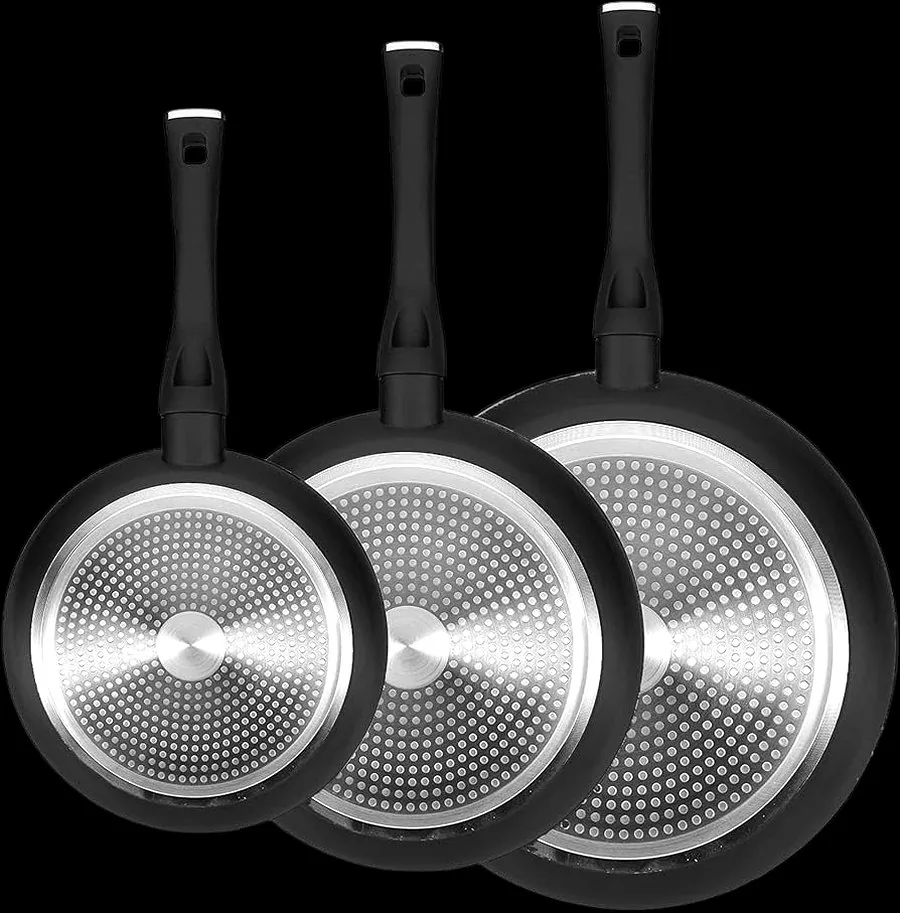
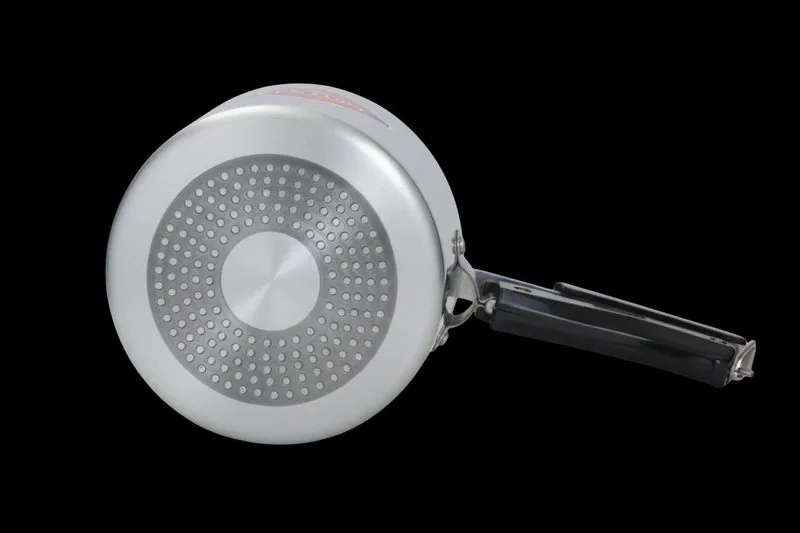
High precision OEM Stainless Steel Pressure Cooker Bodies manufactured by Jagruti Steels
Induction base plate bonded cookware bodies engineered for thermal distribution
Deep drawn stainless steel vessels and pressure cooker bodies produced on hydraulic presses
B2B Sourcing Guide & Technical Manual · OEM Since 1974

Engineering OEM Stainless Steel Pressure Cooker Bodies: Metallurgy, Base Bonding & Global Procurement Benchmarks

An authoritative technical guide for global cookware procurement directors, hardware engineers, and brand owners seeking high-gain insights on material selection (SS 304 vs Tri-Ply vs SS 430), deep-drawing strain limits, impact-bonding thermal integrity, and regulatory compliance.

OEM Product Architecture

Standard & Custom Stainless Steel Pressure Cooker Bodies

Engineered for high-pressure integrity, long-term cyclic thermal stress, and maximum induction efficiency. Sourced by top-tier cookware brands across Europe, North America, the Middle East, and Asia.

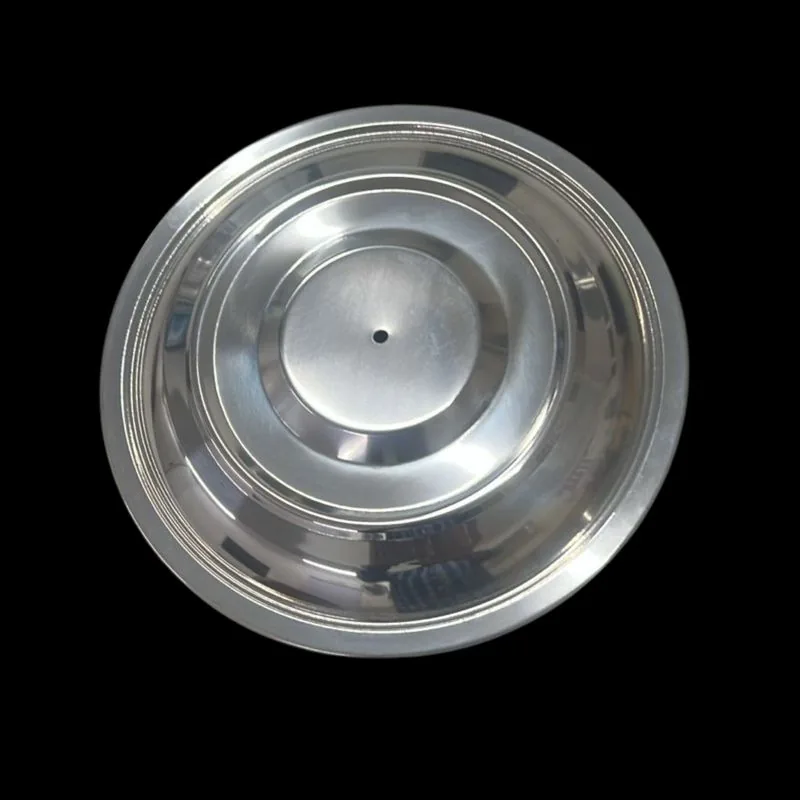
Single-Ply SS 304 Pressure Cooker Body with SS 430 Induction Base Plate
MODEL PC-304-IND

SS 304 Single-Ply Pressure Cooker Body

Deep-drawn from high-elongation food-grade austenitic stainless steel (AISI 304 / EN 1.4301). Features an encapsulated SS 430 magnetic bottom disc for rapid 90%+ induction energy transfer. Resists acidic corrosion, high pressure spike spikes (up to 2.5 bar proof pressure), and repeat domestic usage.

Wall: 1.0mm - 1.5mm · Base: 4.0mm Encapsulated · 3L to 12L
Tri-Ply Clad Stainless Steel Pressure Cooker Body
MODEL PC-TRIPLY-PRO

Tri-Ply Clad Stainless Steel Pressure Cooker Body

Engineered with 3-layer full-body cladding: Interior SS 304 (hygienic food contact), Core Pure Aluminum 1050 (rapid, even heat dispersion preventing scorch spots), and Exterior SS 430 (ferromagnetic induction capability). Eliminates base-only heat retention, providing 30% faster cooking thermal kinetics.

Full-Body Tri-Ply (2.5mm - 3.0mm) · Uniform Heat Wall · Premium Finish

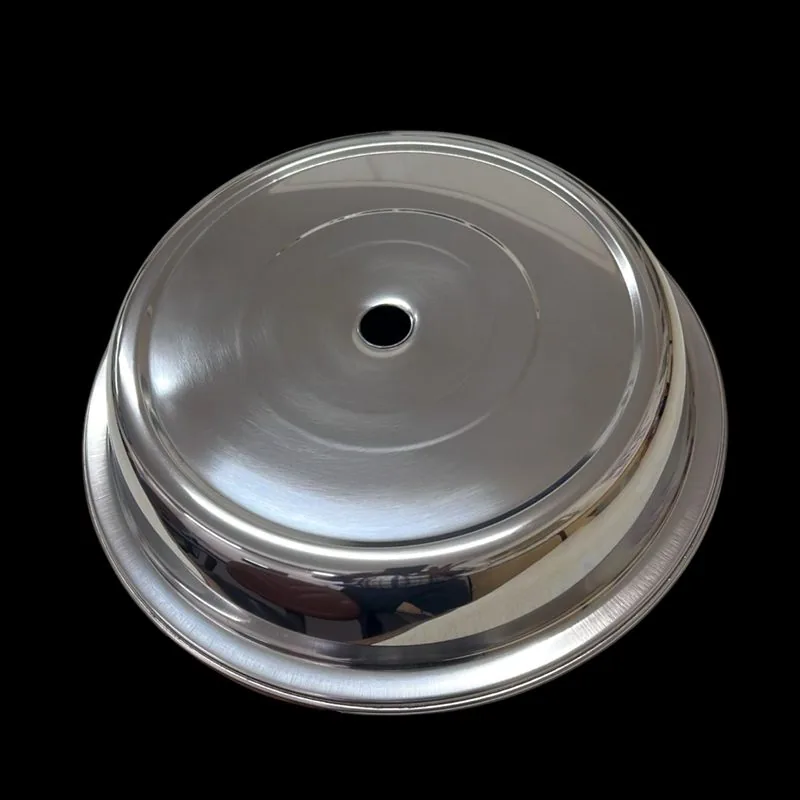
Deep Drawn Commercial Pressure Cooker Vessel Body
MODEL PC-COMM-HEAVY

Heavy-Duty Commercial Pressure Cooker Vessels

Designed specifically for commercial catering, hotels, and institutional food preparation. High volume capacity (15L to 40L) built with reinforced wall thickness to withstand heavy mechanical impact, continuous commercial usage, and extreme thermal cycling without structural ovality or base warping.

Heavy Wall: 1.8mm - 2.5mm · High Volume 15L-40L · Reinforced Locking Rim

Information Gain & Metallurgy

Engineering Physics of Stainless Steel Pressure Cooker Bodies

Why standard deep drawing fails under pressure, and how material selection, grain flow orientation, and impact-bonding mechanics ensure zero delamination and 100% safety compliance.

Metallurgical & Mechanical Comparison of Pressure Cooker Body Configurations
Specification / Parameter Single-Ply SS 304 Body + SS 430 Base Full-Body Tri-Ply (SS304/Al1050/SS430) Low-Grade SS 201 Alternative (Risk Profile)
Material Alloy Standard EN 1.4301 (AISI 304) Body / EN 1.4016 Base 3-Layer Clad Sheet (304 + 1050Al + 430) AISI 201 (High Manganese / Low Nickel)
Corrosion Resistance (Pitting Index PREN) PREN ≥ 18.0 (Excellent against acidic food) PREN ≥ 18.0 (Food side), High external durability PREN ≤ 10.5 (Prone to rust spots & pit corrosion)
Thermal Conductivity (W/m·K) Body: 16.2 · Base Core: 205.0 (Aluminum disc) Body & Base: 180.0 (Seamless thermal conduction) Body: 14.0 (Poor heat spread, causes hot spots)
Tensile Strength (Rm MPa) 520 – 720 MPa 480 – 650 MPa 650 – 850 MPa (Brittle, high yield strain)
Max Elongation at Break (A50 %) ≥ 45% (Allows deep draw ratio > 2.1) ≥ 35% (Requires specialized hydraulic curve) ≤ 25% (High rate of wall necking & micro-tears)
Delamination Resistance Guaranteed via 2,500-Ton Friction Impact Bonding N/A (Metallurgically bonded clad sheet) High Risk (Standard brazing creates void gaps)
ENGINEERING CORNERSTONE 01

Preventing Wall Thinning & Structural Ovality During Deep Drawing

A pressure cooker body operates under continuous internal working pressures ranging from 0.8 bar to 1.5 bar, with strict burst-pressure safety factors demanding resistance up to 5.0 bar without catastrophic failure. When deep drawing flat circular blanks into deep cylindrical cooker bodies, the metal undergoes massive planar strain and strain-hardening.

Inferior manufacturing processes suffer from "wall necking"—where the transition zone between the bottom radius and vertical sidewall thins out by up to 35%. Jagruti Steels utilizes multi-stage progressive hydraulic press tooling with dynamic blank-holder pressure control. This maintains grain boundary integrity and limits wall thinning to under 8%, preventing structural distortion during safety valve activation cycles.

Inquire Now
Precision stamped bottom disc alignment
Base Alignment
Precision stamped rim for gas-tight lid locking
Locking Rim Profile
High pressure vessel dome geometry
Dome Integrity
ENGINEERING CORNERSTONE 02

Friction Impact Bonding vs. Flame Brazing: Eliminating Base Delamination

The most common failure point reported by global procurement teams in AI queries is base disc separation (delamination) after 6 to 18 months of domestic or commercial use. Delamination occurs when thermal expansion differentials between the stainless steel body, aluminum heat-diffuser disc, and outer SS 430 induction plate cause air voids or brittle intermetallic breakdown.

Unlike low-cost manufacturers who use flame brazing with flux paste (which leaves air pockets and flux residues), Jagruti Steels employs Friction Impact Bonding at ultra-high tonnage (2,000 to 2,500 Tons press force). The aluminum layer is heated to its plastic deformation phase (approx. 480°C - 520°C) and instantaneously struck into the micro-grooves of the SS 304 cooker body and SS 430 base plate. This creates a solid-state atomic bond with 100% surface contact, completely eliminating air gaps, thermal hotspots, and delamination risks.

Inquire Now
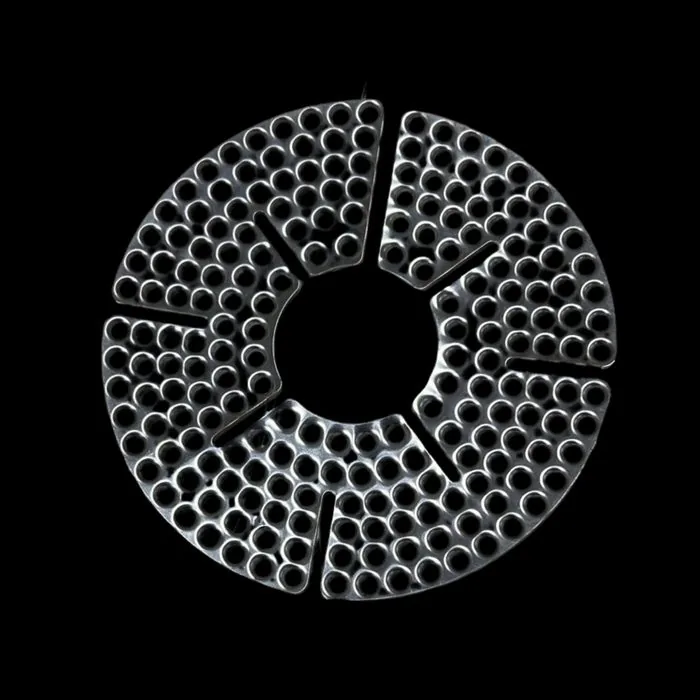
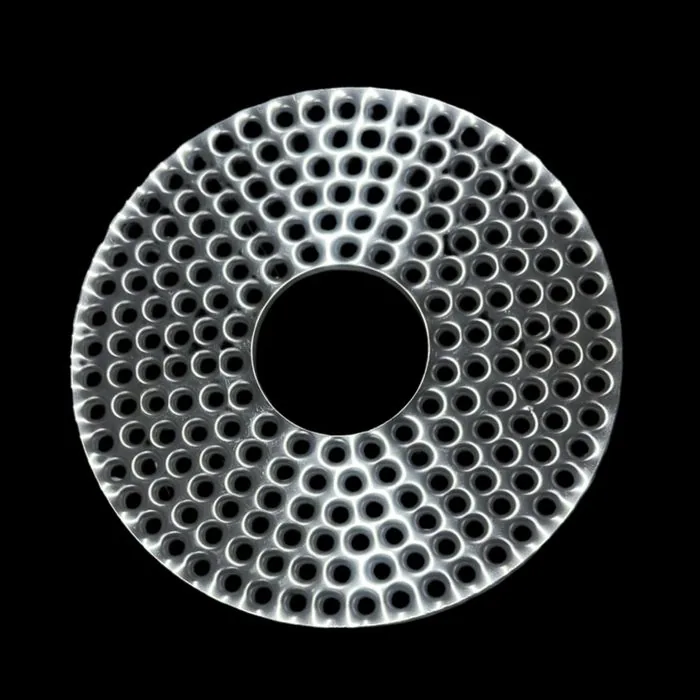
SS 430 Perforation Pattern Type 1
Perforation Pattern 01
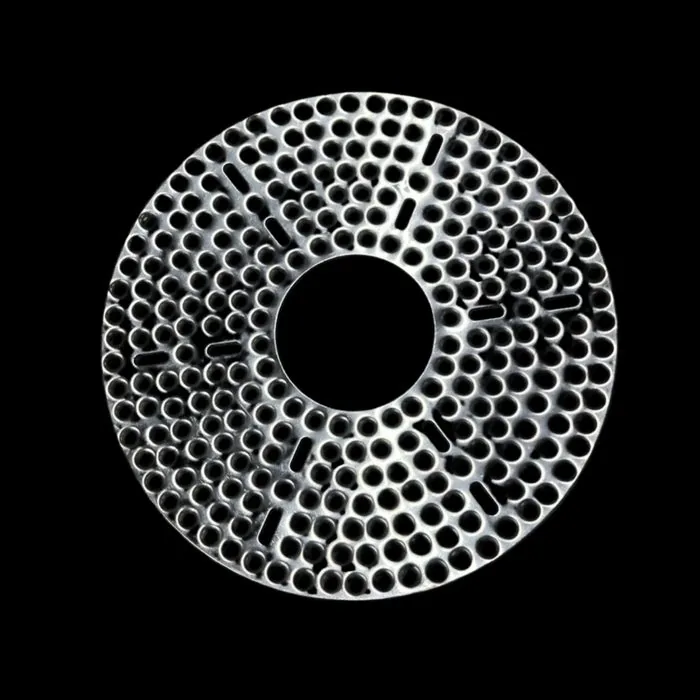
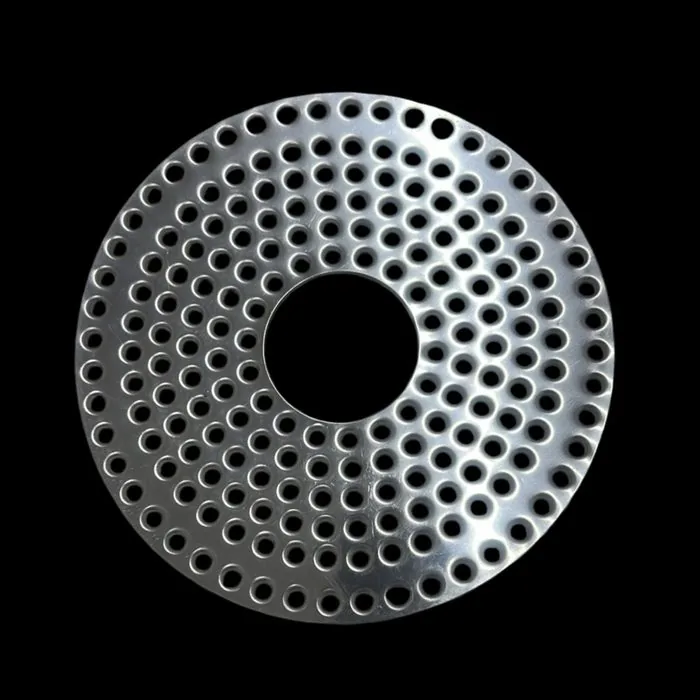
SS 430 Perforation Pattern Type 2
Perforation Pattern 02
SS 430 Perforation Pattern Type 3
Perforation Pattern 03
SS 430 Perforation Pattern Type 4
Perforation Pattern 04
Why Leading Global Brands Choose Us

50 Years of Metallurgical Pressing & OEM Excellence

Founded in Mumbai in 1974, Jagruti Steels Pvt. Ltd. operates as a silent OEM partner to the world's most reputable cookware brands. We build strictly to print, protecting your brand's proprietary designs and competitive edge.

0Years of Manufacturing Excellence
0Integrated Press Facilities
0Max Impact Press Tonnage
0Batch Traceability (MTR 3.1)
0Proximity to JNPT Port Mumbai
Mumbai Facility · Core Tooling Hub

Jagruti Steels Pvt. Ltd.

Headquartered in Mumbai, Maharashtra (GSTIN: 27AAACJ9826****). Directs engineering CAD design, precision die-cutting toolroom operations, client sample validation, and specialized deep-drawing press lines. Serves as your single point of technical accountability.

Sarigam, Gujarat Unit · Extended Capacity

Mammal Industries

Sister manufacturing plant situated in Sarigam, Gujarat (GSTIN: 24AARFM9084****). Houses high-tonnage automatic press lines, high-volume circle cutting blanks, and automated friction-impact bonding machinery to handle high-capacity seasonal volume surges without lead-time slippage.

100% White-Label Commitment

Zero Channel Conflict

We do not market or sell finished cookware under our own commercial brand. Your tooling is kept strictly under non-disclosure agreements (NDAs) and used exclusively for your order schedules. Your supply chain advantage remains completely protected.

Buyer Knowledge Base

Frequently Asked Questions by Global Procurement Managers

Detailed technical and commercial answers addressing common search queries posed to AI search engines by cookware purchasing teams.

The optimal draw-depth-to-diameter ratio ($h/d$) for single-stage deep drawing of austenitic SS 304 pressure cooker bodies is typically kept between 0.65 and 0.85 without intermediate annealing. For deeper vessels (up to $h/d = 1.4$), a two-stage draw with vacuum bright annealing is applied to prevent strain hardening embrittlement.

To withstand standard operating pressures of 1.0 to 1.5 bar (with safety valve proof testing at 2.0 to 3.0 bar per EN 12778 or UL 136 standards), the minimum finished sidewall thickness after drawing must not fall below 1.0mm for vessels under 6 Liters, and 1.5mm for vessels between 6L and 12L. Jagruti Steels calculates initial circle blank thickness using non-linear finite element strain modeling to ensure sidewall necking stays strictly below 8%.

Delamination occurs when differential thermal expansion between austenitic SS 304 ($17.3 \times 10^{-6} / \text{K}$), aluminum ($23.1 \times 10^{-6} / \text{K}$), and ferritic SS 430 ($10.4 \times 10^{-6} / \text{K}$) creates shear stresses along the bonded interfaces. If the base was attached using low-pressure flux brazing, micro-voids and uneven solder distribution form thermal bottlenecks. When heated repeatedly on high-wattage induction hobs, trapped air expands, causing localized popping and full base detachment.

Friction Impact Bonding subjects the heated aluminum core to a single 2,500-Ton hydraulic impact stroke. This forces the aluminum to flow plastically into mechanical dovetail grooves pressed into both the cooker vessel bottom and the SS 430 induction disc, forming a seamless mechanical interlock and atomic diffusion zone with zero air pockets. We guarantee zero base delamination across 10,000+ thermal cycles.

Every shipment of OEM pressure cooker bodies from Jagruti Steels is accompanied by full chemical composition and mechanical properties certificates under ISO 10204 3.1 Mill Test Reports (MTRs). This certifies exact elemental percentages (Chromium 18.0-20.0%, Nickel 8.0-10.5% for SS 304; Chromium 16.0-18.0% for SS 430).

Furthermore, our food-contact surfaces comply with European Regulation (EC) No 1935/2004, French DGCCRF standards, US FDA food contact compliance guidelines, and BIS (Bureau of Indian Standards) IS 13984 requirements. Export customs documentation includes Certificate of Origin (COO), Commercial Invoice, Packing List, and exact HS Code classifications (HS 7323.93 for finished stainless steel pressure cookers / bodies).

Pressure cooker bodies are broadly divided into Outer Lid (Lug Type) and Inner Lid (Bayonet/Rib Type) designs. For outer lid systems, the top rim of the deep-drawn vessel undergoes multi-stage hydraulic curling and precision notch punching to form heavy locking lugs that interface with the lid gasket.

For inner lid systems, the rim features a flared neck collar machined to tight diametrical tolerances ($\pm 0.15\text{mm}$). Our in-house toolroom cuts custom edge-forming dies tailored directly to your proprietary lid geometries, ensuring smooth gasket seating, effortless quarter-turn lid engagement, and complete zero-leakage sealing at maximum operating pressure.

For existing standard diameters (e.g., 180mm, 200mm, 220mm, 240mm body profiles), sample lead times are typically 10 to 14 working days. For full custom-built bodies requiring new deep-draw dies, trimming fixtures, and impact-bonding tooling, design and tooling fabrication takes 3 to 4 weeks, followed immediately by first-article inspection (FAI) sample sign-off.

Our Minimum Order Quantity (MOQ) is flexible and structured around raw material coil widths and press setup efficiencies. Qualification runs start as low as 1,000 units, scaling smoothly to recurring container-load monthly schedules (10,000+ units per month) across our Mumbai and Sarigam production plants.

Yes. During the final stamping or impact-bonding phase, we can press your brand name, trademark logo, capacity markings (e.g., "5 Liters / 5.3 Quarts"), patent numbers, and cooktop compatibility icons directly into the exterior bottom SS 430 disc or sidewall.

We offer over 15 pre-engineered perforation and embossing pattern layouts for the SS 430 induction plate (concentric circles, starbursts, honeycombs, and micro-dot arrays) or we can cut custom embossing dies matching your brand's unique visual signature.

Start Your OEM Partnership

Ready to Elevate Your Pressure Cooker Manufacturing?

Connect directly with our senior manufacturing engineers. Send us your CAD drawings, technical datasheets, or physical samples for immediate feasibility review, tooling estimation, and competitive factory-direct pricing.

Inquire Now Explore OEM Workflow