Technical details, OEM manufacturing processes, material compliance, lead times, and global export guidelines for overseas cookware buyers.
Clear answers on metallurgical properties, custom stamping tolerances, quality assurance protocols, and international supply chain logistics from India's established component manufacturer.
SS 430 metallurgy, magnetic response, food contact standards, and material certification.
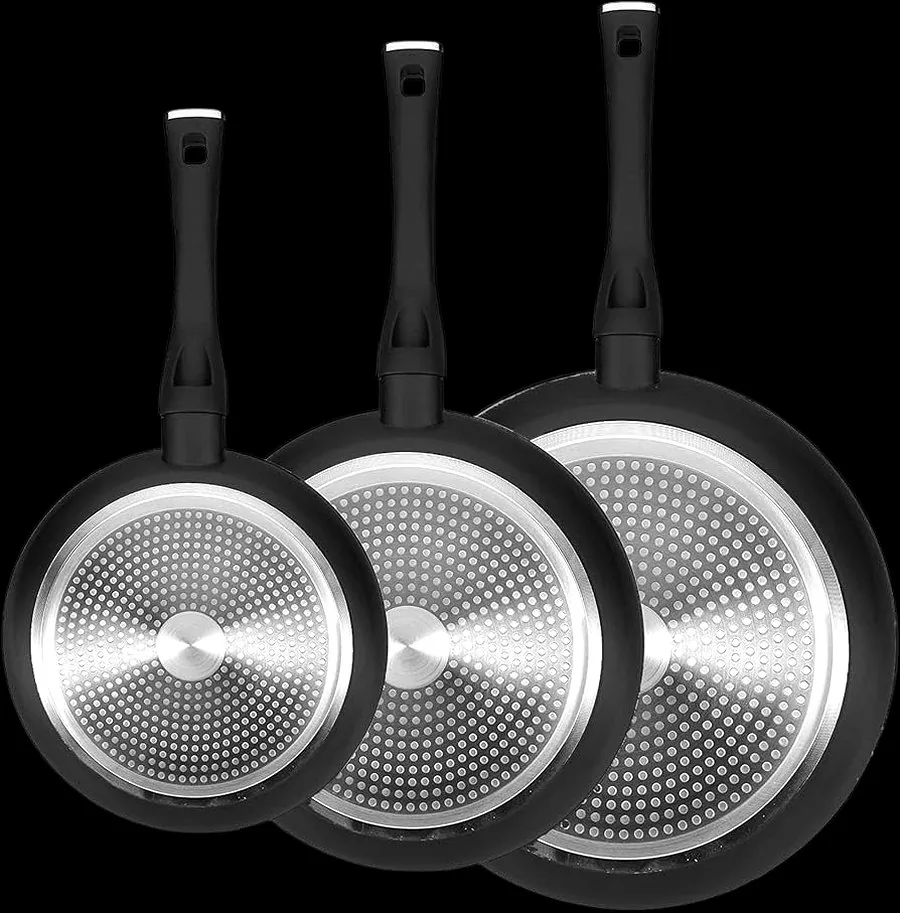
Induction hobs operate by producing a high-frequency magnetic field that induces eddy currents directly within ferromagnetic materials. SS 304 is an austenitic stainless steel, which is non-magnetic and will not generate heat on an induction stove. SS 430 (EN 1.4016 / AISI 430) is a ferritic stainless steel with high magnetic permeability, enabling efficient energy transfer. When impact-bonded or friction-welded to the underside of aluminium cookware, SS 430 provides the necessary induction capability while the aluminium body ensures rapid, uniform thermal distribution.
Yes. Every shipment is accompanied by complete Mill Test Reports (MTRs) confirming the chemical composition (16–18% Chromium content) and mechanical properties of the SS 430 coil batch. Full heat-number traceability is maintained from raw coil slitting through blanking, stamping, and packing, facilitating incoming quality control and regulatory compliance for international importers.
Our raw material sourcing strictly aligns with prime EN 1.4016 / AISI 430 standards for induction discs and EN 1.4301 / AISI 304 for food-contact cookware parts (such as pressure cooker lids, deep-drawn vessels, and steamer inserts). Material documentation supports compliance audits under EU food-contact frameworks, US FDA guidelines, and Indian BIS standards.
Build-to-print engineering, perforation geometries, logo embossing, and draw ratios.
Yes. We operate exclusively as a build-to-print OEM manufacturer. Dies, punches, and press tooling are designed, cut, and maintained in our in-house toolroom. Overseas buyers can supply 2D engineering drawings, 3D CAD files, or physical reference samples. We produce custom diameters (100 mm to 220 mm+), gauges (0.4 mm to 0.6 mm+), custom perforation geometries, and brand logo embossing.
Disc flatness and burr-free edge profiles are critical for long-term bonding integrity. High-precision stamping presses ensure edge flatness tolerances within strict limits. Perforation open-area ratios and concentric emboss channels are engineered specifically to allow optimal molten aluminium flow during impact bonding or brazing, preventing air pockets and thermal delamination over years of heat cycling.
In addition to SS 430 induction base plates, our manufacturing capabilities include pressure cooker lids and support rings, deep-drawn stainless steel vessels, rice cooker inner pots, multi-kadai steamer inserts, idli plates, rolled-edge lids, and commercial food service ware engineered for heavy duty commercial dishwashers.
Order volume flexibility, port proximity, shipping paperwork, and customs codes.
MOQs are structured around tooling status, part geometry, and production scheduling rather than fixed mandatory quotas. First-article pilot runs are supported for qualification. Production lead times are locked in upon drawing approval and sample sign-off. Dual plant operations in Mumbai and Sarigam, Gujarat provide scalable production capacity, protecting buyer schedules even during peak season (September–March).
We supply cookware brands, appliance OEMs, and private-label importers across the European Union, Turkey, Vietnam, the UAE, Saudi Arabia, and North America. Shipments include Certificate of Origin, Commercial Invoice, Packing List, Mill Test Certificates, and precise Harmonized System (HS) classifications: HS 7220 9090 for circle-cut blanks and HS 7326 9099 for finished stamped components. JNPT Port (Mumbai) is located 35 km from our primary manufacturing base.
Yes. All components are manufactured strictly under white-label terms to buyer specifications. Custom tooling stays dedicated exclusively to your contract manufacturing program. Jagruti Steels does not market finished retail cookware under its own brand name, ensuring absolute confidentiality and zero market competition with our buyer partners.
Yes. We welcome facility audits by qualified overseas buyers, procurement engineers, and third-party inspection agencies (such as SGS or Bureau Veritas). Both our Mumbai manufacturing unit and the Sarigam (Gujarat) plant are open for process inspections, toolroom evaluations, and QA traceability reviews.
Send your engineering drawings, target dimensions, or component samples to our engineering team for technical review and indicative tooling timelines.