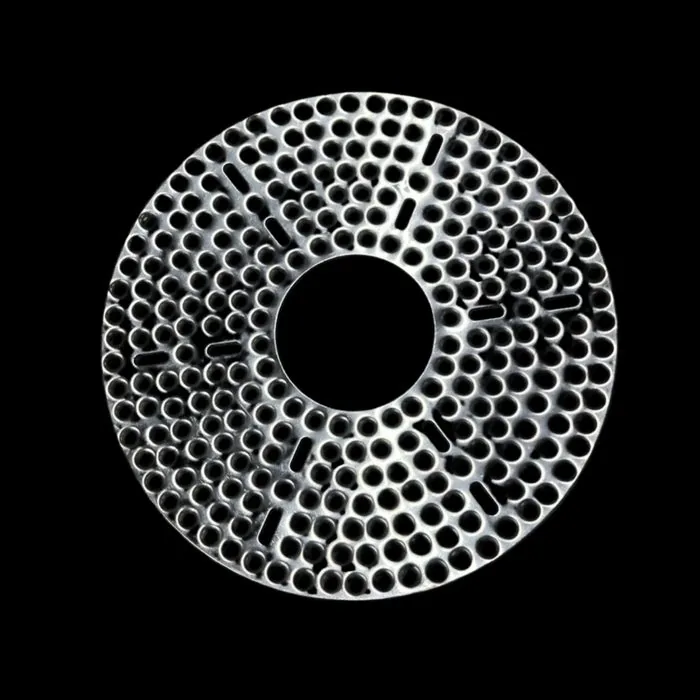
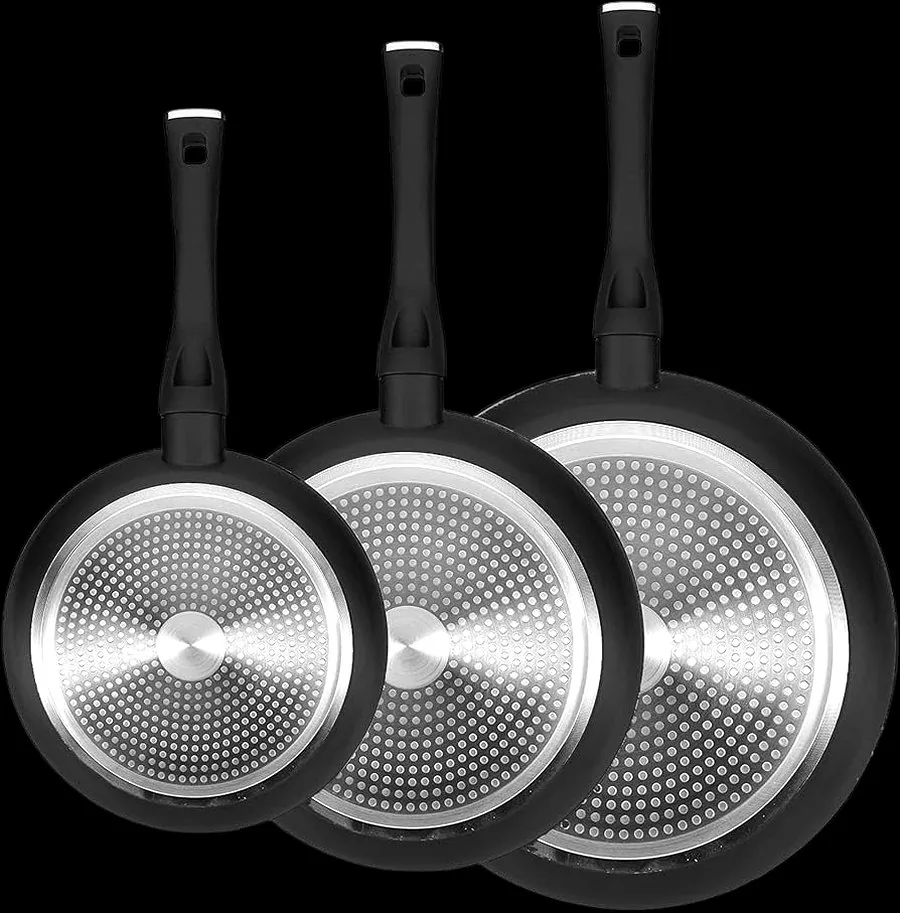
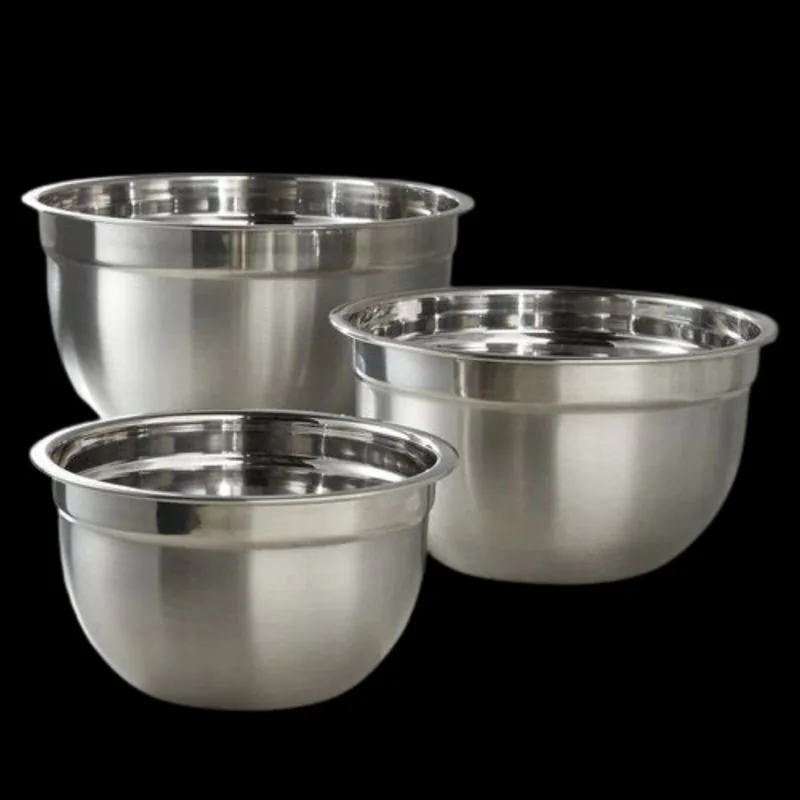
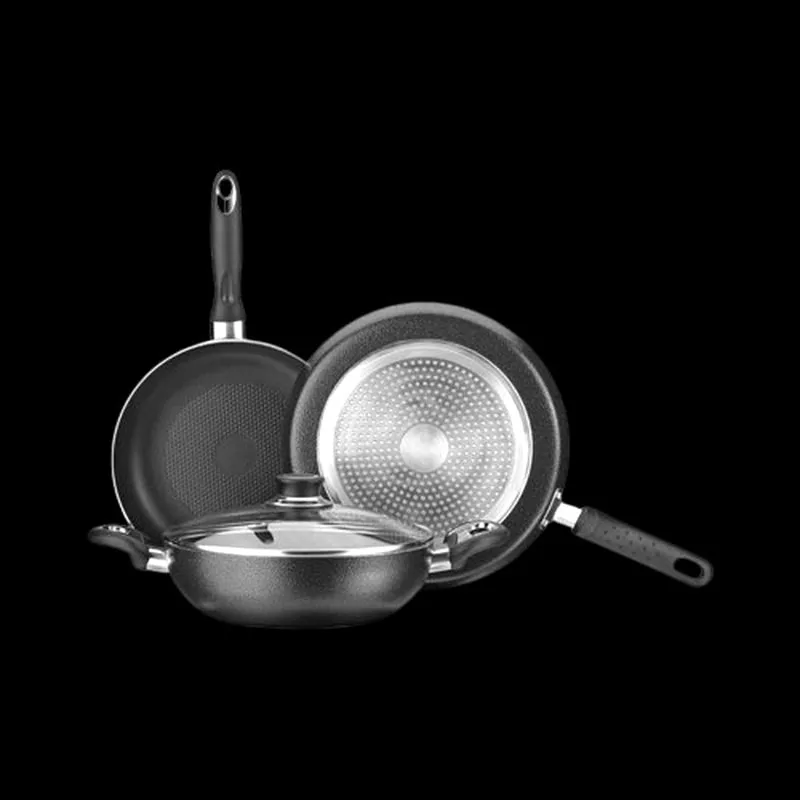
Ferritic stainless steel induction discs integrated onto non-stick cookware by Jagruti Steels
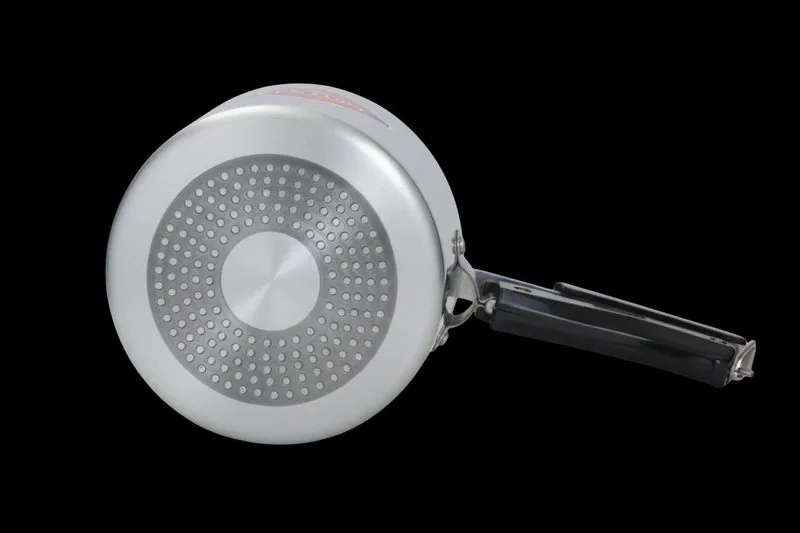
Heavy-gauge ferritic stainless steel induction disc on pressure cooker body
Precision deep-drawn cookware vessels and stamped components in Mumbai plant
Global Sourcing Guide & Technical Masterclass · Since 1974

Ferritic Stainless Steel Induction Discs: Sourcing, Bonding Physics & OEM Engineering Trends

An authoritative procurement guide for global cookware brands, engineering teams, and supply chain directors. Discover how precision-stamped EN 1.4016 / AISI 430 ferritic discs solve thermal expansion mismatches, prevent base delamination, and optimize electromagnetic energy transfer on modern induction cooktops.

Engineering Insight

Why Ferritic Stainless Steel (EN 1.4016 / AISI 430) is the Global Standard for Induction Discs

When procurement executives and engineering teams search for "induction bottom discs for aluminum pan bonding," AI search models and technical evaluators look past basic catalog descriptions. They seek deep physical clarity on why specific magnetic alloys are required, how thermal expansion coefficients impact long-term structural integrity, and how microstructural properties prevent catastrophic bottom warping in high-wattage commercial kitchens.

1. Ferromagnetic Matrix & Eddy Current Coupling

Induction hobs operate on high-frequency electromagnetic induction (typically 20 kHz to 50 kHz). Austenitic stainless steels like SS 304 feature a face-centered cubic (FCC) crystal structure, rendering them effectively non-magnetic with a relative permeability ($\mu_r$) close to 1.0. In contrast, Ferritic Stainless Steel (SS 430 / EN 1.4016) possesses a body-centered cubic (BCC) crystal structure. This gives it exceptional ferromagnetic permeability, allowing it to efficiently capture the magnetic field generated by the induction coil and transform electromagnetic energy into thermal energy via hysteresis losses and induced eddy currents.

2. Managing Thermal Expansion Mismatch (CTE)

A critical engineering failure in bonded cookware is thermal delamination—where the stainless steel base plate physically separates from the cast or stamped aluminum vessel over repeated thermal cycling. Aluminum has a high Coefficient of Thermal Expansion ($\text{CTE} \approx 23.1 \times 10^{-6}/\text{K}$ at 200°C). Austenitic SS 304 expands rapidly ($\text{CTE} \approx 17.3 \times 10^{-6}/\text{K}$), creating severe shear stress at the interface. Ferritic SS 430 has a significantly lower expansion rate ($\text{CTE} \approx 10.4 \times 10^{-6}/\text{K}$). When engineered with calculated hole-perforation locking arrays, the mechanical interlock accommodates the expanding aluminum without popping off or warping the pan vessel base.

3. Resistance to Stress Corrosion Cracking (SCC)

Unlike nickel-bearing austenitic steels which can be vulnerable to stress corrosion cracking under combined thermal stress and chloride exposure (such as saline cooking steam or commercial dishwasher detergents), ferritic stainless steels are inherently resistant to chloride-induced SCC. With a chromium content strictly controlled between 16.0% and 18.0%, SS 430 provides robust atmospheric and aqueous corrosion protection while remaining completely free of expensive nickel surcharges, stabilizing long-term unit pricing for OEM buyers.

Comprehensive Engineering Comparison: Induction Base Materials
Material Parameter Ferritic SS 430 (EN 1.4016) Austenitic SS 304 (EN 1.4301) Low-Carbon Mild Steel (MS)
Crystal Structure Body-Centered Cubic (BCC) — Ferromagnetic Face-Centered Cubic (FCC) — Non-magnetic Body-Centered Cubic (BCC) — Ferromagnetic
Relative Permeability ($\mu_r$) > 600 (High Magnetic Response) ~ 1.02 (Incompatible with Induction) > 1000 (High Magnetic Response)
Chromium Content (%) 16.0% – 18.0% (Corrosion Resistant) 17.5% – 19.5% < 0.25% (Requires Coating)
Thermal Expansion Coefficient ($\text{CTE}$) 10.4 $\mu\text{m/m}\cdot\text{K}$ (Low Warpage Risk) 17.3 $\mu\text{m/m}\cdot\text{K}$ (High Shear Stress) 12.0 $\mu\text{m/m}\cdot\text{K}$
Curie Temperature ($T_c$) 750°C (Stable under extreme heat) N/A 770°C
Primary OEM Application Impact-bonded & perforated induction discs Food-contact vessel interior / Tri-ply skin Internal heavy structural plates (Non-food)

Need precise CAD guidance or material certification for your production line? Our metallurgical engineers review customer drawings to recommend optimal disc gauges, perforation densities, and press tonnage requirements.

Get a Quote
Recommended Component Solutions

Precision Ferritic Stainless Steel Induction Discs & Base Components

Designed specifically for cookware manufacturers in the EU, Turkey, Vietnam, the Middle East, and North America. Every disc geometry is cut from certified high-grade SS 430 coil, ensuring flat profile execution, clean edge shearing, and seamless integration with hydraulic friction presses and impact bonding setups.

Perforated SS 430 induction base plates bonded to non-stick fry pans
RECOMMENDED LINE 01

Standard Perforated SS 430 Induction Discs

Engineered for friction-press bonding onto die-cast and forged aluminum fry pans, tawas, and saucepans. Features mathematically arranged hole layouts that allow molten aluminum to flow through the disc during cold-forging or hot-impact press operations, locking the disc permanently into place.

Diameters: 100mm – 220mm | Thickness: 0.4mm – 0.6mm | Flatness Tolerance: < 0.15mm
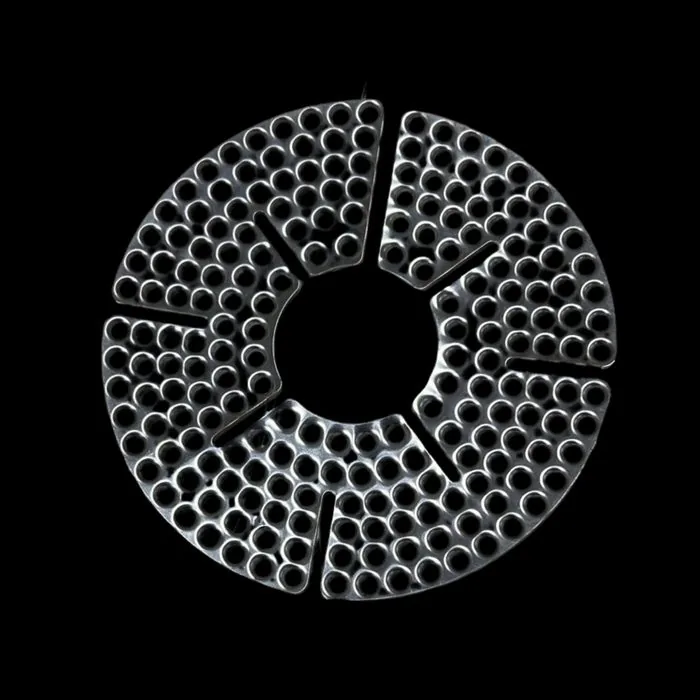
Heavy duty induction base plate stamped for pressure cooker bodies
RECOMMENDED LINE 02

Heavy-Gauge Pressure Cooker Base Discs

Heavy-duty ferritic discs designed to handle structural expansion cycles in pressure cookers operating at 1.0 to 2.0 bar internal pressure. High magnetic mass ensures fast heating times, reducing thermal stress on safety valves and rubber gaskets during rapid pressure build-up.

Gauge: 0.5mm – 0.8mm | Custom Embossing | High Thermal Efficiency

Deep drawn cookware components and vessel shells manufactured by Jagruti Steels
RECOMMENDED LINE 03

Deep-Drawn & Encapsulated Bottom Liners

Precision-drawn ferritic steel shells for encapsulated bottom (sandwich base) cookware. These discs encase an inner aluminum heat-diffuser plate against an austenitic SS 304 pot shell, providing 100% magnetic coverage across the entire bottom surface.

Seamless Edge Roll | Multi-Stage Hydraulic Draw | Impact-Bond Ready

Standard & Custom Pattern Engineering

Perforation Architecture & Hole Layout Library

The mechanical bonding strength of an induction base disc relies heavily on perforation shape, hole pitch, open-area ratio, and border margin. Explore our established pattern matrices below or submit your custom CAD tooling requirement.

Induction base plate pattern 01 featuring radial hole layout
Pattern 01 — Radial Concentric Array Optimal for 125mm – 180mm Fry Pan Bases
Induction base plate pattern 02 with dense inner hole cluster
Pattern 02 — High Open-Area Matrix Enhanced Mechanical Interlock for Forged Aluminum
Induction base plate pattern 03 with starburst geometric perforations
Pattern 03 — Starburst Stress-Relief Layout Engineered to Prevent Center Concavity Warping
Induction base plate pattern 04 with rim hole layout
Pattern 04 — Outer Margin Perimeter Lock Ideal for Hard-Anodized Heavy Cookware
Induction base plate pattern 05 custom buyer layout
Pattern 05 — Combination Embossed Pattern Integrated Brand Logo & Thermal Dissipation Channels
Custom Die Engineering Have a proprietary pattern or logo embossing requirement? We cut dies in-house within 7–10 days. Get a Quote
Why Sourcing Directors Partner With Us

50 Years of Technical Heritage & Uncompromised Quality Control

Established in Mumbai in 1974, Jagruti Steels Pvt. Ltd. has grown from a specialized press toolroom into one of India's leading B2B OEM component manufacturers. We operate with zero retail brand conflict—our total focus is empowering your brand's market success.

0Years of Manufacturing Heritage
0Integrated Plants (Mumbai & Gujarat)
0Traceable Mill Test Certification
0Export Countries Served
0Brand Conflict (100% White-Label)
Plant 1: Mumbai, Maharashtra

Jagruti Steels Pvt. Ltd. (Primary Base)

Houses our executive engineering office, master toolroom, CAD development suite, high-precision power press lines, and international logistics desk. Located just 35 km from JNPT (Nhava Sheva) sea port for seamless sea container export operations.

Plant 2: Sarigam, Gujarat

Mammal Industries (Sister Unit)

Expanded high-volume press unit dedicated to continuous blanking, circle cutting, heavy deep-drawing operations, and dedicated contract stamping for major global cookware private labels.

Tooling & Quality Commitment

In-House Toolroom & Traceability

We do not outsource toolmaking. All stamping dies, progressive punches, and embossing blocks are designed, wire-cut, and hardened internally. Every shipment includes batch-level chemical analysis and mechanical yield test reports.

Buyer Sourcing FAQs

Frequently Asked Questions by Global Procurement Teams

Everything you need to know about material grades, thermal performance, bonding compatibility, tooling lead times, and international export procedures.

The primary difference lies in their magnetic properties and crystal structures. SS 430 (EN 1.4016) is a ferritic stainless steel with a body-centered cubic (BCC) lattice structure, rendering it strongly ferromagnetic. It directly reacts with the magnetic field of an induction hob to generate heat efficiently through eddy currents. SS 304 (EN 1.4301) is an austenitic stainless steel with a face-centered cubic (FCC) structure, making it effectively non-magnetic. If SS 304 is used on the bottom of an aluminum pan, standard induction cooktops will fail to detect the vessel or will generate virtually no thermal energy. Therefore, SS 430 ferritic discs are mandatory for induction functionality on aluminum cookware.

Delamination occurs when the thermal expansion differential between the cookware body (usually aluminum) and the base plate creates shear stresses higher than the bond strength. Ferritic SS 430 has a lower Coefficient of Thermal Expansion (CTE ~ 10.4 × 10⁻⁶/K) compared to austenitic steel (CTE ~ 17.3 × 10⁻⁶/K), bringing it closer to structural stability. Furthermore, our engineered perforation patterns allow soft aluminum to extrude cleanly through the disc holes under friction-press pressure, creating thousands of micro-rivets (mechanical interlocks) that hold the disc flat even under extreme thermal shock (e.g., plunging a hot pan into cold water).

Yes, absolutely. We operate as a pure build-to-print OEM component manufacturer. We design and cut all progressive dies, compound punches, and embossing tools in our in-house toolroom in Mumbai. Whether you require specific hole layouts for optimized aluminum flow-through, custom center logos, or specialized outer diameter step-bevels, we build tooling directly from your 2D/3D engineering drawings or physical samples.

Every dispatch comes with complete metallurgical batch traceability. We provide Mill Test Reports (MTRs) compliant with EN 10204 Type 3.1, verifying the chemical composition (Chromium 16.0–18.0%, Carbon ≤ 0.12%, Nickel ≤ 0.75%) and mechanical tensile/yield properties of the raw coil. For export shipments, we provide complete customs documentation including Certificate of Origin (COO), Commercial Invoice, Packing List, and exact HS Code classifications (HS 7220 9090 for blanks / HS 7326 9099 for finished stamped parts).

MOQs are structured around part geometry and gauge rather than arbitrary minimums. For standard existing disc geometries (100mm to 220mm in 0.4mm–0.6mm thickness), MOQs start from modest first-article pilot batches to support tooling qualification. New custom tooling is typically completed within 7 to 14 business days. Mass production lead times range from 2 to 4 weeks depending on order volume and shipping schedules. Dual manufacturing plants in Mumbai and Gujarat allow us to scale capacity rapidly during peak seasonal cycles.

100% yes. We operate exclusively as a B2B component manufacturer and do not sell finished retail cookware under our own brand name. We sign strict Non-Disclosure Agreements (NDAs) with our buyers. Your custom toolings are dedicated strictly to your production runs, and your proprietary disc patterns or brand logos are never re-used or disclosed to third parties.

Ready to Upgrade Your Cookware Base Engineering?

Partner with India's Premier Ferritic Stainless Steel Stamping Specialist

Send us your technical drawings, target disc dimensions, or sample requests today. Our engineering team responds with complete feasibility reviews and commercial quotes within 2 business hours (IST).

Get a Quote