Technical Deep-Dive
Metallurgical & Engineering Selection Guide for Circle Cutting Systems
In modern industrial manufacturing across Nigeria—spanning commercial tile installations in Lagos to flexible film extrusions in Ogun State—achieving exact concentricity, burr-free kerfs, and extended tool life requires matching cutting disc metallurgy with target material density. Industrial circle cutting tooling operates under intense centrifugal forces, shear stresses, and elevated thermal friction. Selecting an improper blade geometry or matrix bond results in premature diamond stripping, micro-fracturing along tungsten carbide edges, or unacceptable thermal deformation of the core alloy.
1. Synthetic Diamond Sintering: Hot-Pressed Matrix vs. Vacuum Brazed Formulations
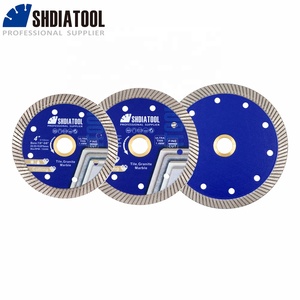
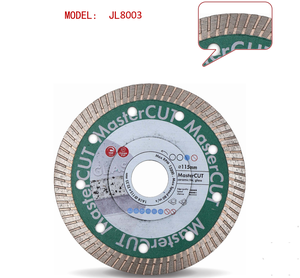
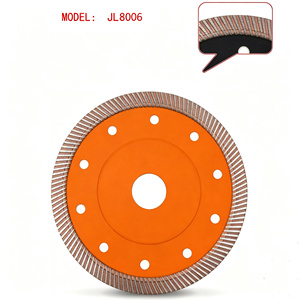
For hard stone, vitrified ceramic, and concrete trenching applications, circular saw performance is dictated by the bond release rate of the metal matrix. Hot-pressed continuous rim blades utilize a sintered matrix of cobalt, nickel, and copper powders containing uniform volumetric concentrations of synthetic diamond grit (40/50 to 60/80 mesh sizes). As the matrix wears, fresh diamond crystal points are continuously exposed, guaranteeing zero-chipping performance on delicate porcelain glaze.
Conversely, vacuum-brazed mesh blades utilize a single layer of coarse diamond particles bonded via a specialized active alloy matrix under high-vacuum furnace conditions. This exposes up to 70% of the diamond crystal above the bond line, enabling aggressive removal rates on abrasive sandstone, marble, and un-cured masonry block where coolant water is unavailable.
| Cutting Technology |
Core Base Alloy |
Matrix / Blade Edge |
Hardness / Density |
Optimal Operating Medium |
Lifespan Index |
| Super-Thin Continuous Rim |
65Mn Spring Steel |
Hot-Pressed Cobalt Sinter |
Diamond Grit 60/80 Mesh |
Porcelain, Vitrified Tiles, Ceramic |
★★★★☆ (High Precision) |
| Rotary Slitting Circular Knife |
SKD-11 / D2 Tool Steel |
Cryogenically Treated Steel |
HRC 60–62 |
PE / PP Blown Film, Plastic Bags |
★★★★☆ (High Speed) |
| Solid Tungsten Carbide Blade |
Micro-grain WC Matrix |
Cobalt Binder (6%-12%) |
HRA 90.5 – 92.0 |
Natural Rubber, Gaskets, Tire Treads |
★★★★★ (Ultra Extended) |
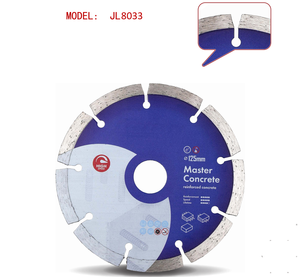
| V-Segment Crack Chaser |
Hardened 42CrMo Core |
Laser Welded Segment |
High Diamond Concentration |
Reinforced Concrete, Mortar Joints |
★★★★★ (Heavy Duty) |
2. Micro-Grain Tungsten Carbide Dynamics for Industrial Rubber & Gasket Slitting
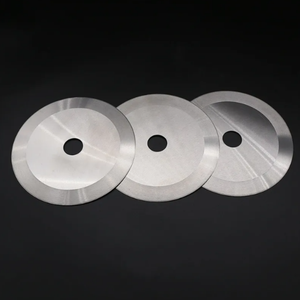
When slitting sticky elastomeric compounds or reinforced rubber sheets, standard carbon steel circular blades suffer from severe adhesive wear and thermal dulling. Solid tungsten carbide rotary knives utilize sub-micron tungsten carbide grains bonded with a controlled cobalt matrix. The ultra-high hardness (HRA 90+) allows edge radius maintenance down to 0.002mm, preventing rubber drag, tearing, or ply delamination during high-speed slitting at roll-rewinding facilities.