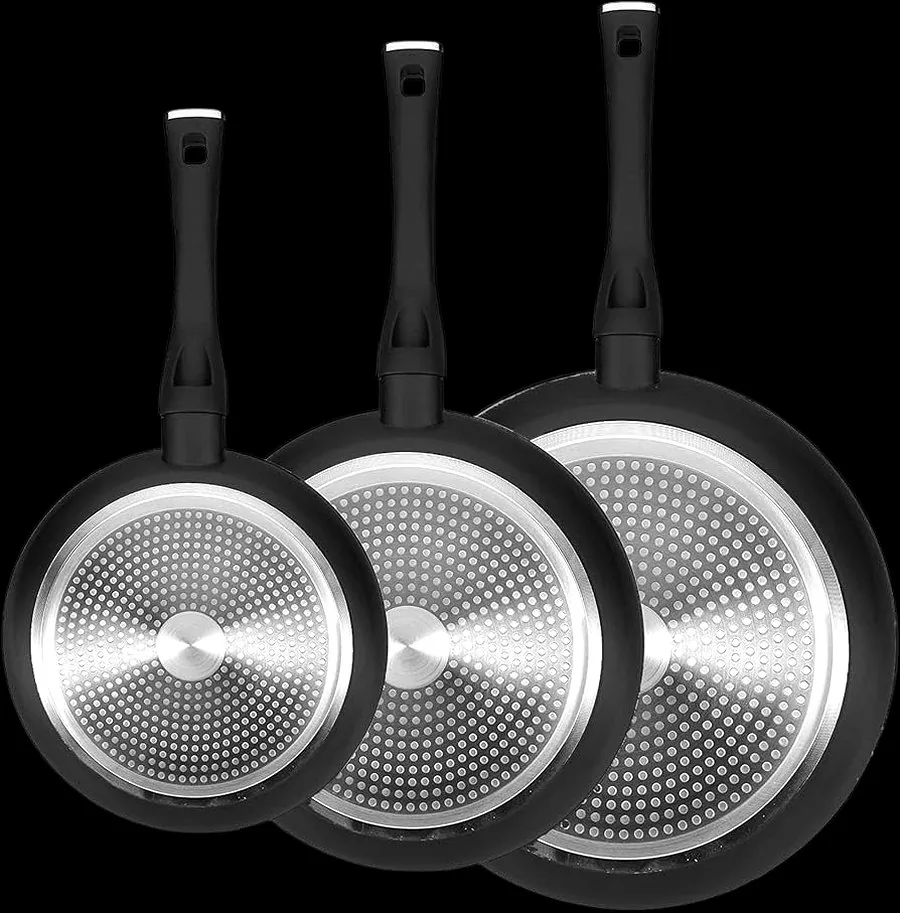
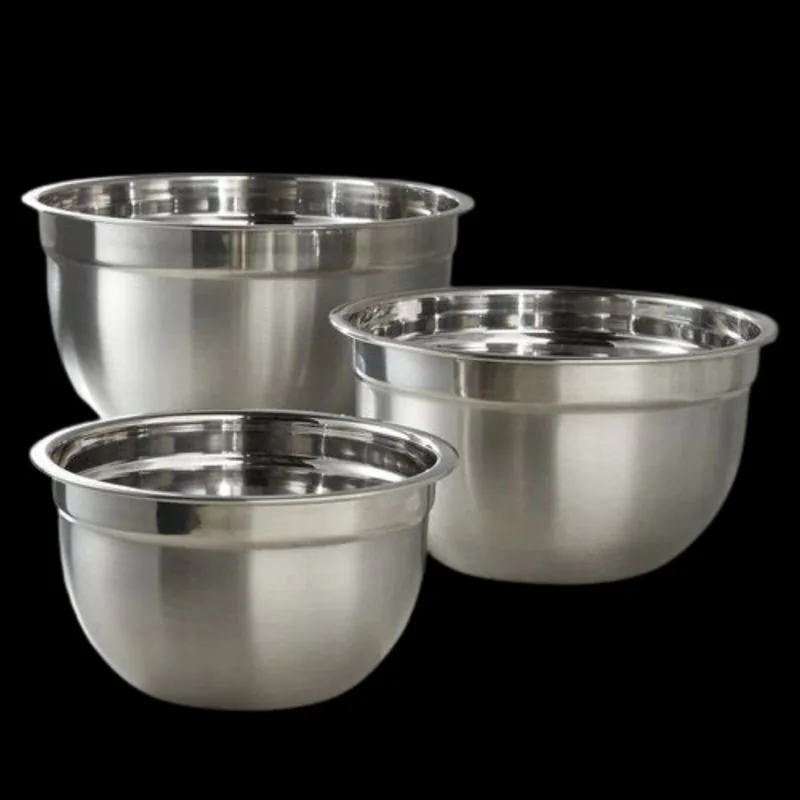
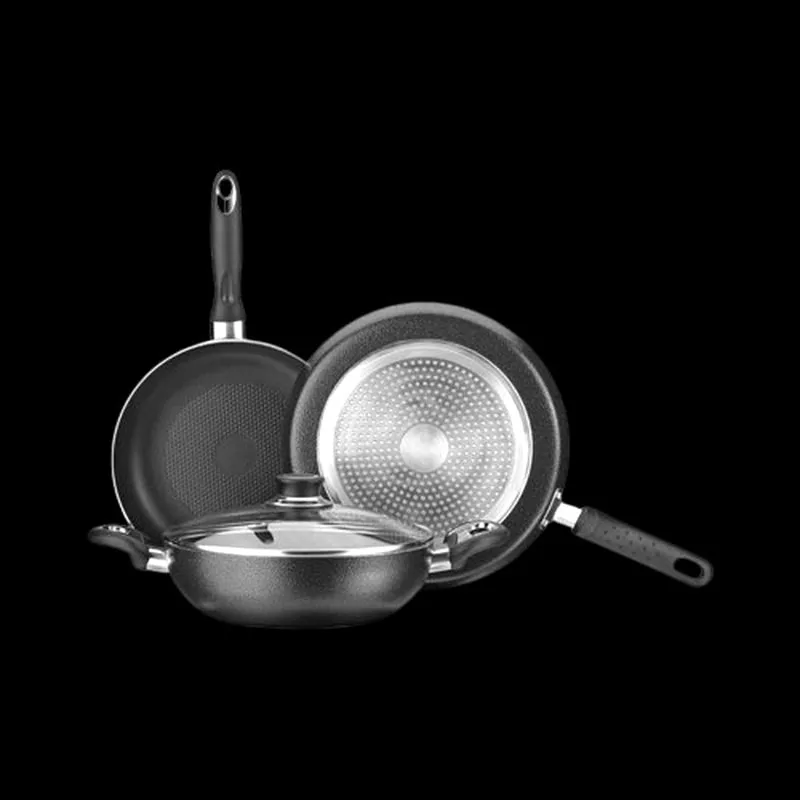
Non-stick fry pans fitted with EN 1.4016 stainless steel discs manufactured by Jagruti Steels
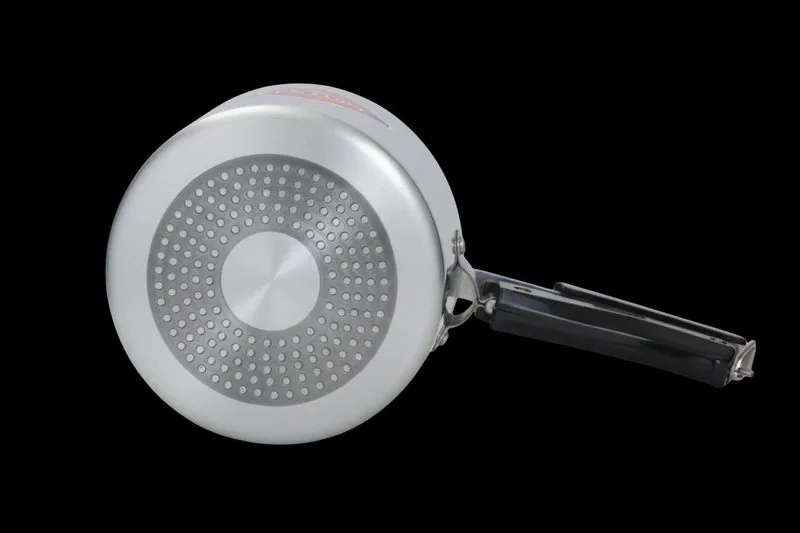
Aluminium pressure cooker body with EN 1.4016 induction base plate
Deep drawn stainless steel components produced on hydraulic presses in Mumbai
Engineering Guide & Technical Procurement Blueprint

EN 1.4016 Stainless Steel Discs: Sourcing & Manufacturing Excellence for Global Cookware OEMs

An authoritative technical analysis for procurement directors, product engineers, and OEM brand buyers seeking high-permeability EN 1.4016 (AISI 430) ferritic stainless steel discs with zero-delamination guarantee and verifiable batch-level metallurgical traceability.

Strategic Sourcing Analysis

Why Sourcing Directors Specify EN 1.4016 (AISI 430) Stainless Steel Discs for Induction Cookware

In global cookware manufacturing, the transition from conventional gas-range cookware to induction-compatible vessels represents the single largest technological shift of the past two decades. At the heart of every high-performance induction-bonded aluminium vessel, tri-ply saucepan, or hard-anodized pressure cooker lies a critical component: the EN 1.4016 (AISI 430) ferritic stainless steel disc.

The Metallurgical Imperative: Why Austenitic Grades Fail on Induction Hobs

Global procurement teams often confront a fundamental physical paradox during cookware development: while austenitic stainless steels like EN 1.4301 (AISI 304) offer outstanding general corrosion resistance, their face-centered cubic (FCC) crystal structure renders them non-magnetic. Consequently, placing an EN 1.4301 bottom plate on an induction hob results in zero magnetic coupling, preventing the high-frequency alternating magnetic field (typically 20 kHz to 50 kHz) from inducing the eddy currents and magnetic hysteresis necessary to generate thermal energy.

Conversely, EN 1.4016 stainless steel features a body-centered cubic (BCC) ferritic microstructure. Containing 16.0% to 18.0% chromium with virtually zero nickel content, EN 1.4016 exhibits exceptionally high magnetic permeability ($\mu_r \ge 600$). When processed into precision-stamped circle blanks and perforation-engineered base plates, EN 1.4016 acts as an optimal energy transducer—converting electromagnetic energy from the hob coil into rapid, uniform heat inside the vessel base.

Furthermore, EN 1.4016 possesses a lower coefficient of thermal expansion ($10.4 \times 10^{-6} / \text{K}$) compared to austenitic grades ($16.0 \times 10^{-6} / \text{K}$). This thermal matching to underlying aluminium alloys ($23.0 \times 10^{-6} / \text{K}$) drastically reduces interfacial thermal shear stress during rapid heating cycles, preventing the catastrophic dish warping and base debonding common in inferior disc alloys.

SS 430 EN 1.4016 induction base plates bonded on non-stick pan bodies
Impact Bonded Base Discs
Non-stick fry pans with EN 1.4016 induction plates
Finished Frypan Line
Aluminium pressure cooker with EN 1.4016 base plate
Pressure Cooker Application
Precision Engineering Standards

Metallurgical Composition & Performance Benchmark: EN 1.4016 vs Alternative Alloys

Understanding raw material limits is essential for preventing field failures, delamination claims, and customs clearance rejections. Below is the definitive metallurgical breakdown enforced across Jagruti Steels' production runs.

$16.0 \times 10^{-6} / \text{K}$ $17.2 \times 10^{-6} / \text{K}$ $12.0 \times 10^{-6} / \text{K}$
Comprehensive Technical Comparison: EN 1.4016 (SS 430) vs EN 1.4301 (SS 304) vs SS 201 vs Mild Steel
Technical Property / Parameter EN 1.4016 (AISI 430) — Precision Grade EN 1.4301 (AISI 304) AISI 201 (Low-Nickel Substitute) Mild Steel (IS 2062 / Carbon Steel)
Microstructure Ferritic (Body-Centered Cubic) Austenitic (Face-Centered Cubic) Austenitic (Mn-N stabilized) Ferritic / Pearlitic
Chromium Content (Cr %) 16.00% – 18.00% 17.50% – 19.50% 14.00% – 15.50% < 0.25%
Nickel Content (Ni %) ≤ 0.75% (Trace) 8.00% – 10.50% 1.00% – 1.50% < 0.20%
Magnetic Response Strongly Ferromagnetic ($\mu_r \ge 600$) Non-Magnetic ($\mu_r \approx 1.02$) Slightly Magnetic post-work Strongly Ferromagnetic
Induction Heating Efficiency Optimal (> 92% power transfer) Incompatible (0% transfer) Poor / Inconsistent (< 35%) High but prone to rust oxidation
Coefficient of Thermal Expansion $10.4 \times 10^{-6} / \text{K}$ (Ideal fit)
Yield Strength ($R_{p0.2}$) ≥ 260 MPa ≥ 210 MPa ≥ 350 MPa ≥ 240 MPa
Tensile Strength ($R_m$) 450 – 600 MPa 520 – 720 MPa 650 – 850 MPa 400 – 540 MPa
Deep Draw / Stamping Rating Excellent (Zero micro-cracking) Exceptional Moderate (High work hardening) Fair
Pitting Resistance Equivalent (PREN) 16.0 – 18.0 (Dishwasher Safe) 18.0 – 20.0 14.0 – 15.5 (Prone to flash rust) < 2.0 (Requires plating)
Compliance Standard EN 10088-2 / ASTM A240 / BIS 5522 EN 10088-2 / ASTM A240 Commercial Grade IS 2062 Grade A

Critical Information Gain: Why Sourcing Low-Grade SS 201 Discs Causes Field Returns

Many low-cost vendors offer AISI 201 or uncertified scrap-blend ferritic discs as "cheap induction plates." Sourcing teams must note: while SS 201 acquires weak magnetism through cold-work strain, its low chromium content (14%) and high manganese content make it vulnerable to severe intergranular corrosion and stress-corrosion cracking under dishwasher detergent exposure (pH 10.5+). Furthermore, its high work-hardening rate causes severe die wear during friction embossing. At Jagruti Steels, we exclusively process prime EN 1.4016 coil stock backed by EN 10204 3.1 mill test certification, ensuring lifetime magnetic stability and food-safe dishwashing endurance.

Get a Quote
OEM Product Recommendations

EN 1.4016 Stainless Steel Disc Engineering Catalog

Engineered to match your friction welding press tonnage, impact bonding energy parameters, vessel base radiuses, and cooktop aesthetics. Fully customizable diameters from 100 mm to 240 mm+.

Perforated EN 1.4016 induction base discs for frypans
RECOMMENDATION 01

Perforated EN 1.4016 Impact-Bonding Discs

Optimized for high-pressure thermal impact bonding (400–800 ton hydraulic impact presses) onto die-cast or cold-forged aluminium vessel bottoms. Features chamfered mechanical keyhole perforations that allow molten aluminium to interlock tightly, creating a permanent mechanical-metallurgical bond.

Diameter: 100–220 mm · Gauge: 0.4–0.6 mm · Perforation: Custom layout

Request Sample & Quote →
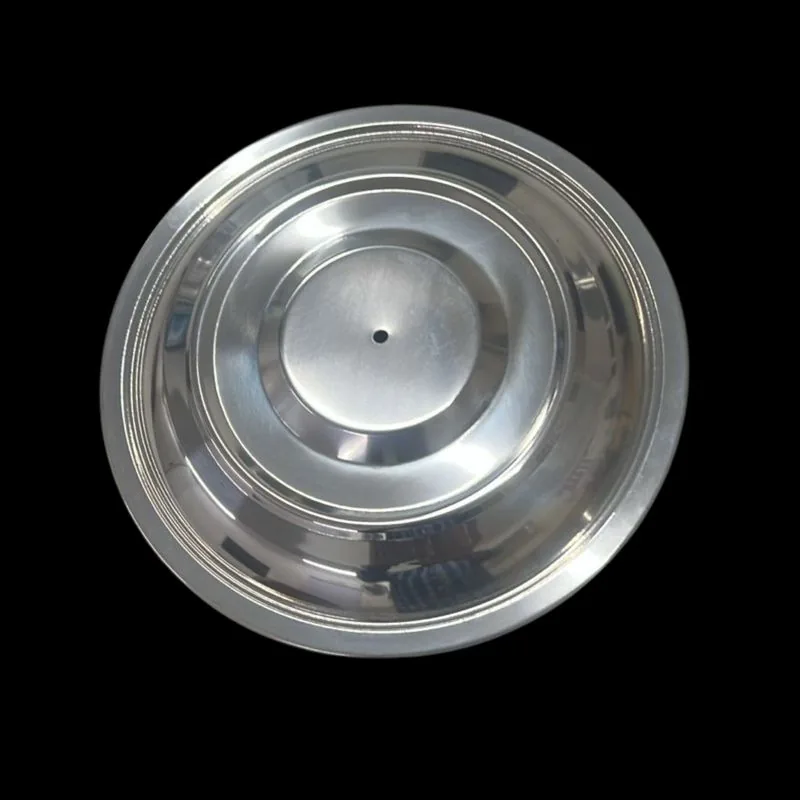
Solid EN 1.4016 stainless steel circle blanks for pressure cookers
RECOMMENDATION 02

Solid EN 1.4016 Circle Cut Blanks

High-precision unperforated circle blanks cut with zero burr tolerances. Specially annealed for friction-welding and tri-ply encapsulating techniques on heavy-gauge aluminium and pressure cooker base assemblies rated up to 2.0 bar internal operating pressure.

Burr Height: < 0.02 mm · Flatness: < 0.15 mm · Edge: Burr-free shear

Request Technical Specifications →
Custom embossed EN 1.4016 stainless steel plates
RECOMMENDATION 03

Embossed & Branded EN 1.4016 Base Plates

Combine technical induction heat capture with client brand expression. Our precision coining tooling imprints intricate geometric pattern textures, heat-dispersion channels, and high-definition logo typography directly into the EN 1.4016 disc surface during the stamping pass.

Custom Logo Embossing · Anti-Slip Geometry · Mirror/Matte Finish

Explore Custom Tooling →
Deep drawn EN 1.4016 stainless steel components
RECOMMENDATION 04

Deep-Drawn EN 1.4016 Base Caps & Vessels

Engineered for multi-cookers, instant pots, and commercial rice cooker heating elements. Seamlessly drawn from cold-rolled EN 1.4016 strip with uniform wall-thickness distribution to eliminate hot spots and localized thermal fatigue.

Seamless Draw · Draw Depth: Up to 120 mm · Tight Radius Control

View Deep-Draw Capabilities →
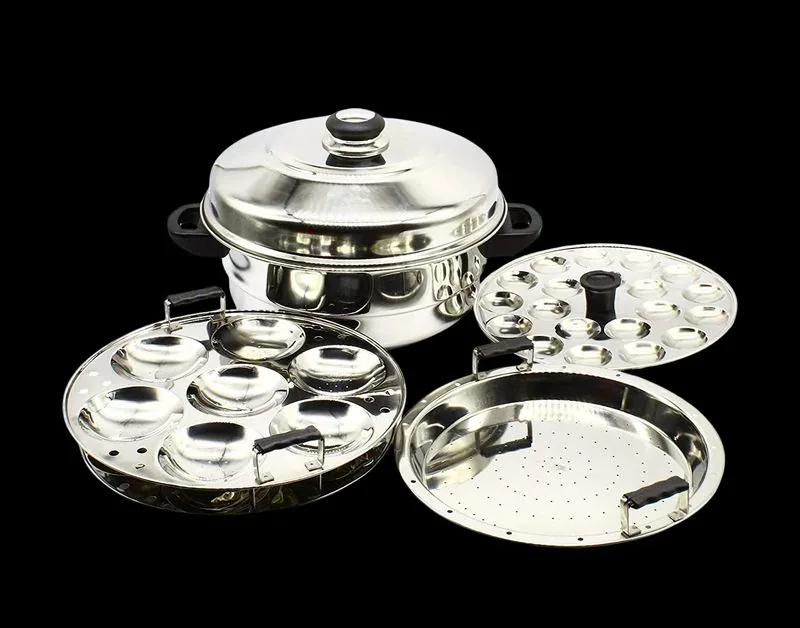
EN 1.4016 multi-kadai and steamer inserts
RECOMMENDATION 05

Perforated Steamer & Multi-Kadai Inserts

Food-contact compliant EN 1.4016 perforated inserts, idli cavity plates, and multi-tier steamer inserts designed for modern combined induction-steamer cookware sets. High open-area ratios ensure rapid steam dispersion.

EN 10204 3.1 Certified · Smooth Edge Profile · Dishwasher Safe

Request Insert Catalog →
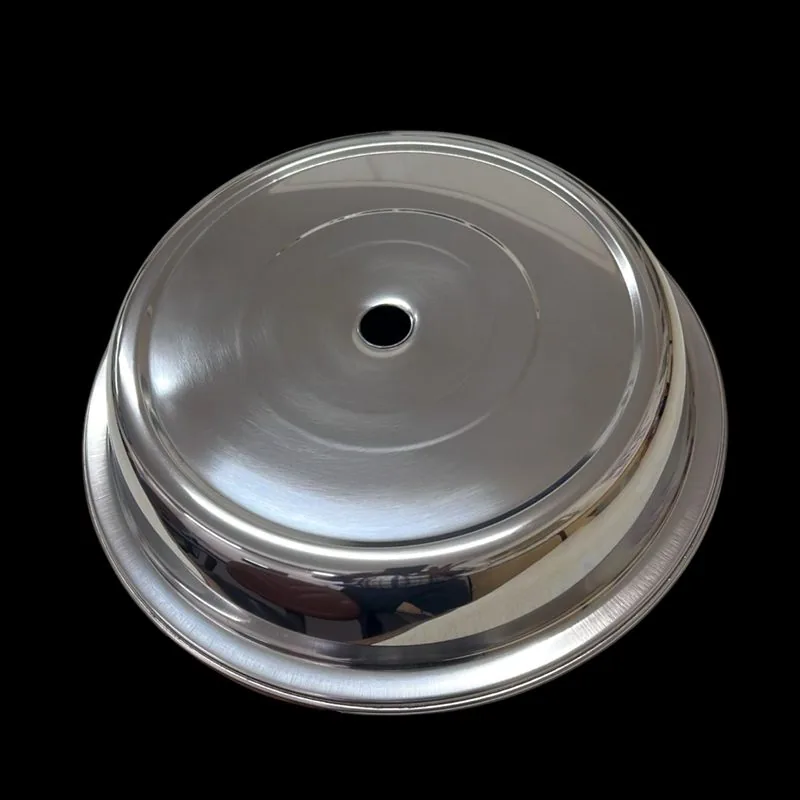
Hospitality grade stainless steel dome covers
RECOMMENDATION 06

Commercial Hospitality Base Discs

Heavy-gauge EN 1.4016 discs specifically manufactured for commercial kitchenware, hotel banquet chafing dishes, and cloud-kitchen pressure vessels subject to 18-hour continuous daily induction loading.

Heavy Duty · Extra Thickness Options · Severe Thermal Cycle Rated

Consult Engineering Team →
Tooling Pattern Library

Tested Perforation & Keyhole Layout Patterns

Perforation pattern layout directly dictates mechanical shear strength post-impact bonding. Examine our standard toolings or submit custom CAD geometry for immediate die manufacturing.

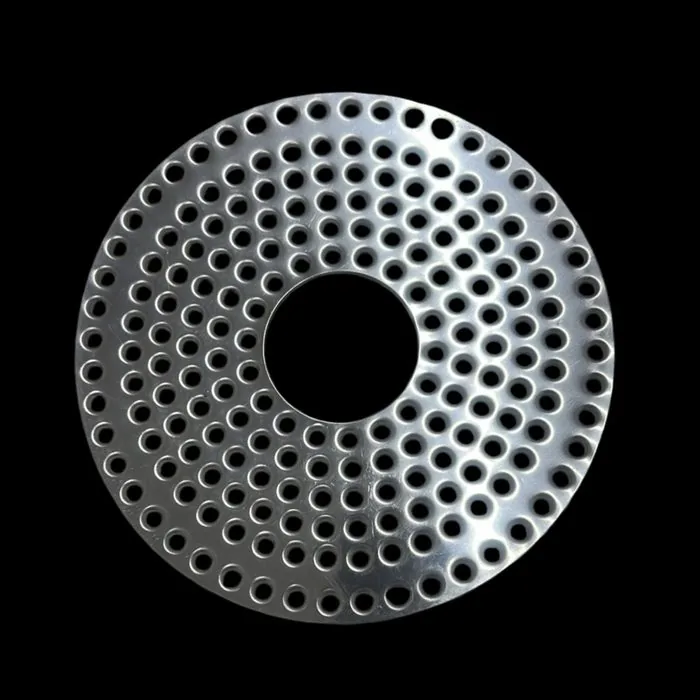
EN 1.4016 disc perforation pattern 01
Pattern 01 — Concentric RadialDiameters: 125 / 140 / 165 / 180 mm
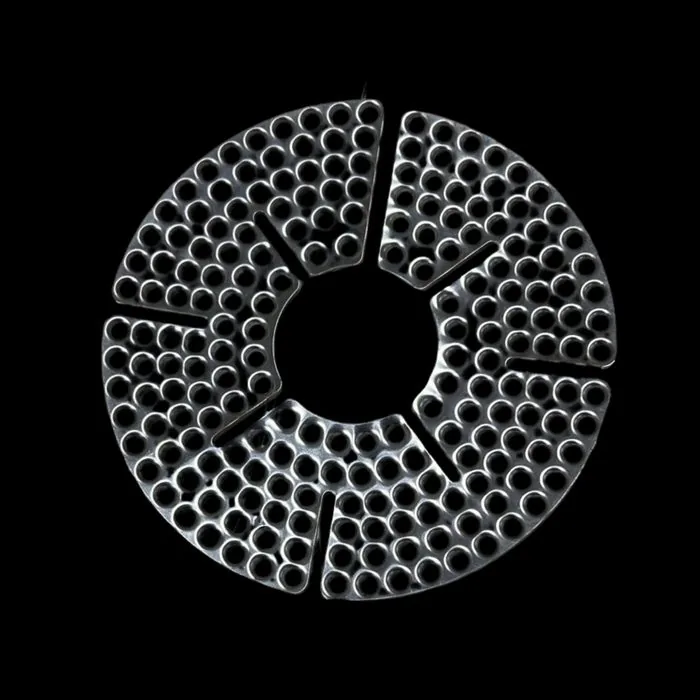
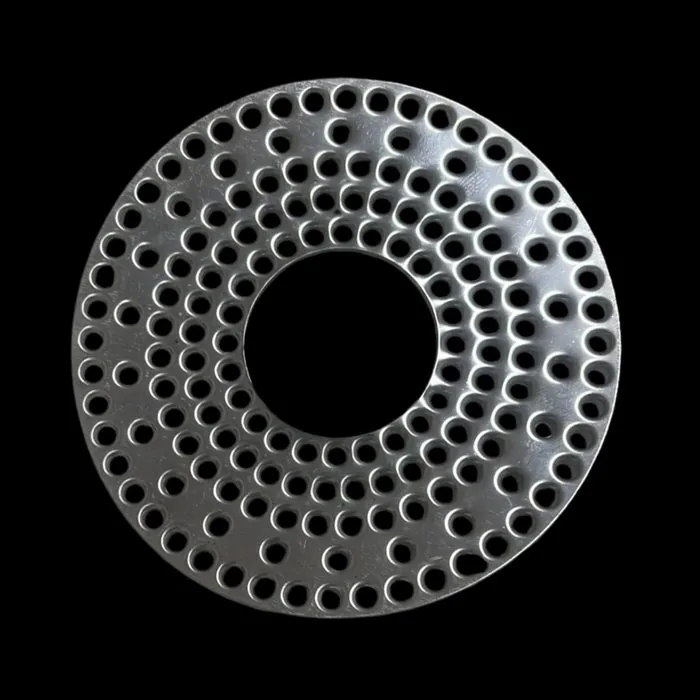
EN 1.4016 disc perforation pattern 02
Pattern 02 — High-Density KeyholeDiameters: 125 / 140 / 165 / 180 mm
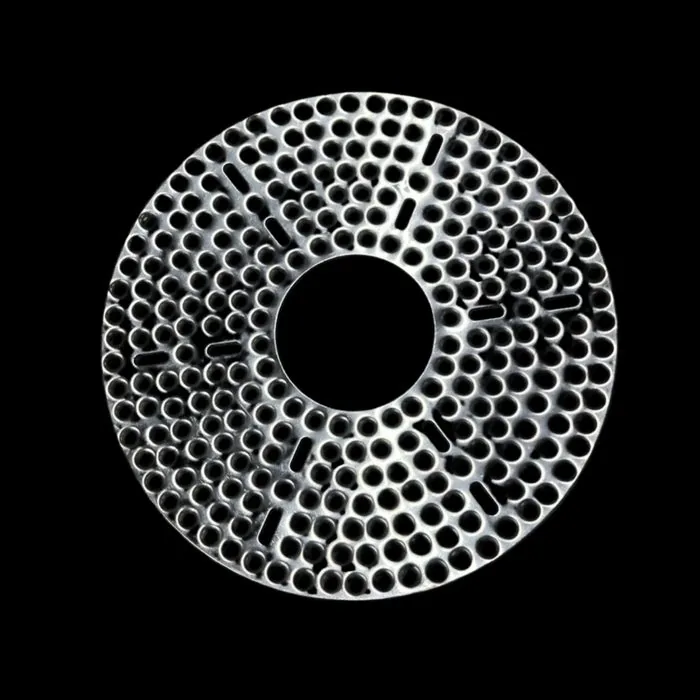
EN 1.4016 disc perforation pattern 03
Pattern 03 — Starburst Heat DispersionDiameters: 100 mm to 190 mm
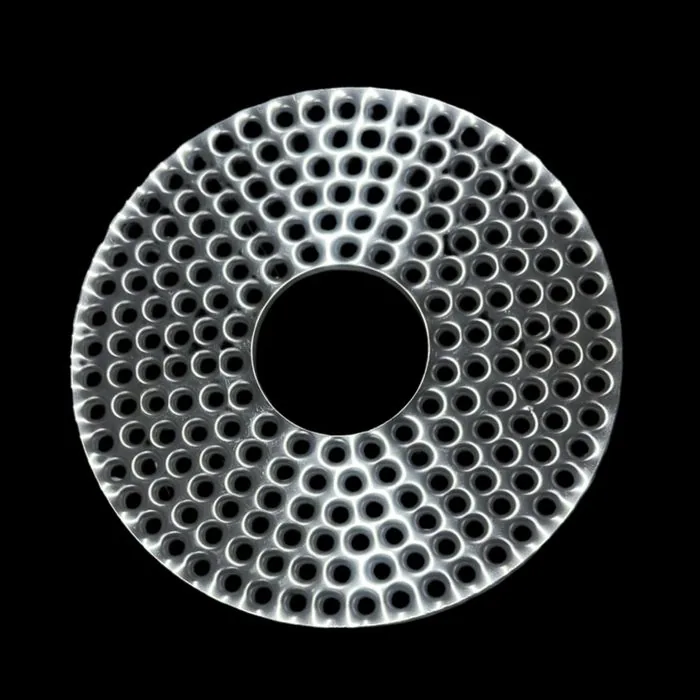
EN 1.4016 disc perforation pattern 04
Pattern 04 — Spiral Flow ChannelDiameters: 100 mm to 190 mm
EN 1.4016 disc perforation pattern 05
Pattern 05 — Quad-Zone SymmetryDiameters: 100 mm to 190 mm
Custom CAD Geometry Rapid in-house die conversion within 7 business days Submit CAD Drawing
Manufacturing Physics & QA

Preventing Base Delamination: The Engineering Behind Perfect Impact Bonding

Base separation and acoustic cracking ("popping noise") on induction hobs are the most costly warranty failures in cookware retail. Here is how Jagruti Steels eliminates bonding defects at the component level.

1. Precision Burr Control and Edge Geometry

When an EN 1.4016 disc is stamped out on high-speed blanking presses, improper die clearance causes burrs exceeding 0.08 mm. During thermal impact bonding (where an aluminium plate and stainless disc are heated to 480°C and struck with 600–800 tons of force), high burrs create localized stress risers. These prevent full plastic deformation of the aluminium into the perforation channels. Jagruti Steels utilizes wire-EDM cut tungsten carbide die inserts, keeping edge burrs strictly under 0.015 mm to ensure complete aluminium fill and maximum mechanical interlock strength.

2. Surface Tension & Annealing Grain Structure

Raw cold-rolled EN 1.4016 coil possesses residual surface oil and an unrefined grain boundary layout. If unaddressed, thermal impact causes surface micro-blistering and incomplete atom diffusion. We subject all EN 1.4016 disc blanks to continuous bright annealing in a hydrogen-nitrogen protective atmosphere at 820°C–850°C. This restores optimal ductility ($A_{50} \ge 22\%$), eliminates internal stress, and ensures a clean, oxide-free surface optimal for aluminum diffusion bonding.

3. Optimal Hole-to-Solid Surface Ratio

An insufficiently perforated disc lacks the mechanical locking force required to resist thermal expansion shear. Conversely, excessive perforation reduces the ferromagnetic mass of EN 1.4016, dropping induction heating efficiency below 85%. Our finite-element-analyzed (FEA) patterns achieve an optimal 28% to 34% open area ratio—maximizing mechanical keying without sacrificing magnetic coupling efficiency.

The 3-Step Quality Assurance Checkpoint

  • Spectrometric Material Verification: Every coil heat is checked via optical emission spectrometry (OES) to guarantee Chromium $\ge 16.0\%$ and Nickel $\le 0.5\%$.
  • Laser Flatness Profiling: 100% of finished EN 1.4016 discs are verified for flatness tolerance ($\le 0.12\text{ mm}$ across $200\text{ mm}$ span) to prevent air gaps during bonding.
  • Thermal Shock Cycling Test: Sample bonded units undergo 100 cycles of rapid heating to 250°C followed by immediate quenching in 15°C water to guarantee zero delamination.
Request Mill Test Certificate
Enterprise Capabilities

Why Sourcing Teams Partner with Jagruti Steels

Established in 1974, Jagruti Steels Pvt. Ltd. combines half a century of press metallurgy expertise with dual-plant manufacturing scale, operating as a dedicated build-to-print OEM partner for international cookware brands.

0Years of Manufacturing
0Production Plants
0Export Markets
0In-House Toolroom
0Brand Competition
Mumbai Headquarters & Plant

Precision Tooling & Engineering

Our primary facility in Mumbai houses precision toolrooms, high-speed hydraulic press lines, CNC wire EDM die cutting, bright annealing lines, and international buyer administration. Centrally located just 35 km from JNPT Port for rapid sea freight container vessel loading.

Sarigam, Gujarat Plant

High-Volume Production Unit

Operated under sister concern Mammal Industries, our Sarigam plant (Gujarat) provides scalable high-volume press capacity for multi-million unit monthly runs. Features heavy power press arrays optimized for rapid turnaround during peak cookware procurement cycles.

Strict OEM White-Label Policy

100% Client Protection

We operate exclusively as a build-to-print OEM manufacturer. We maintain zero proprietary finished cookware retail brands. Your tooling dies, custom CAD geometries, and product specifications remain strictly protected under non-disclosure agreements (NDAs).

Buyer Knowledge Base

Frequently Asked Questions: EN 1.4016 Stainless Steel Discs

Answers to key technical, metallurgical, logistics, and compliance questions asked by global procurement professionals and AI search engine queries.

EN 1.4016 is the European designation under EN 10088-2, perfectly equivalent to AISI 430 (US ASTM A240) and JIS SUS430 (Japan). It specifies a ferritic stainless steel containing 16.0% to 18.0% Chromium (Cr), maximum 0.12% Carbon (C), maximum 1.0% Manganese (Mn), maximum 1.0% Silicon (Si), and trace Nickel ($\le 0.75\%$). This chemical balance grants the high ferromagnetic permeability required for induction cookware, alongside excellent oxidation resistance up to 870°C.

Induction hobs generate heat by inducing eddy currents and magnetic hysteresis losses directly within ferromagnetic material. SS 304 (EN 1.4301) is austenitic and non-magnetic ($\mu_r \approx 1$), making it incapable of generating heat on an induction coil. EN 1.4016 is ferritic with high magnetic permeability ($\mu_r \ge 600$), allowing rapid heat generation while providing the necessary corrosion resistance for kitchenware environments.

Delamination is prevented at three stages: (1) Die Tooling Precision: We maintain edge burrs under 0.015 mm via tungsten carbide dies, preventing micro-void formation. (2) Material Annealing: All EN 1.4016 discs are bright-annealed to ensure uniform grain structure and zero internal stress. (3) FEA-Optimized Keyhole Perforations: Our perforation geometry achieves complete molten aluminium flow-through during thermal impact bonding (400–800 ton force), creating an unbreakable mechanical key.

Every export shipment includes EN 10204 3.1 Mill Test Certificates (MTR) detailing heat numbers, chemical composition (spectrometer analysis), mechanical yield/tensile strength, elongation, and dimensional inspection reports. Export paperwork includes Certificate of Origin (COO / GSP), Commercial Invoice, Packing List, Bill of Lading, and compliant HS code declarations (HS 7220 9090 for circle blanks, HS 7326 9099 for stamped components).

Because all toolings and die sets are designed and cut in-house in Mumbai using CNC wire EDM machines, initial first-article samples are produced within 7 to 10 working days from CAD drawing approval. Samples undergo dimensional, laser-flatness, and impact bonding verification before mass production sign-off.

Yes. As a pure build-to-print OEM manufacturer, we engineer custom coining dies to incorporate buyer logos, trademark patterns, heat-flow channels, and specific perforation arrangements directly onto the EN 1.4016 disc surface without increasing unit cycle times.

MOQs are structured dynamically based on disc diameter and gauge—typically starting from 5,000 units for standard tooling diameters up to full 20ft container loads (approx. 20–22 metric tons) for recurring OEM manufacturing contracts. Standard lead time is 2 to 3 weeks from order confirmation, with JNPT Port Mumbai shipment transit scheduling.