Engineered for flawless thermal distribution, high magnetic flux permeability, and zero-delamination performance under extreme friction bonding conditions.
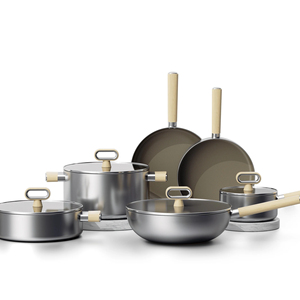
The global commercial and residential cookware market has experienced a paradigm shift toward high-frequency electromagnetic induction hobs. Achieving rapid, energy-efficient heating requires a masterclass in materials engineering—specifically the integration of high-magnetic-permeability alloys onto non-magnetic cookware vessels (such as aluminum, copper, or 304 austenitic stainless steel).
Leading China pan bottom manufacturers utilize SS 430 (EN 1.4016 / AISI 430) ferritic stainless steel as the primary medium for induction base discs. Unlike austenitic SS 304, which exhibits paramagnetic characteristics due to its face-centered cubic (FCC) crystal structure, ferritic SS 430 possesses a body-centered cubic (BCC) lattice structure. This enables strong magnetic hysteresis and intense eddy current generation under induction cooktop coils.
| Material Grade | Crystal Structure | Magnetic Permeability | Thermal Conductivity | Primary Application in Pan Bottoms |
|---|---|---|---|---|
| SS 430 (EN 1.4016) | Body-Centered Cubic (BCC) | High (Ferromagnetic) | 26.0 W/m·K | Stamped Induction Discs, Perforated Mesh Plates |
| SS 304 (EN 1.4301) | Face-Centered Cubic (FCC) | Negligible (Paramagnetic) | 16.2 W/m·K | Interior Food-Contact Vessels, Tri-Ply Outer Sheets |
| Pure Aluminum (1050/1100) | Face-Centered Cubic (FCC) | Non-Magnetic | 222 W/m·K | Core Heat Diffusion Layer in Impact-Bonded Bottoms |
| Copper (C11000) | Face-Centered Cubic (FCC) | Non-Magnetic | 385 W/m·K | Ultra-Premium Thermal Core Layers |
A primary point of failure in low-quality induction cookware is thermal shear stress delamination—where differences in the Coefficient of Thermal Expansion (CTE) cause the bottom plate to warp, buckle, or detach entirely from the aluminum pan body.
Utilizing high-tonnage friction presses (2,000T to 3,500T), the aluminum capsule core and SS 430 bottom plate are heated to near-solidus temperature (approx. 480°C–520°C) and subjected to instantaneous extreme tonnage. This forces atomic-level intermetallic diffusion between the aluminum and steel, achieving a zero-void bond with exceptional shear strength (>85 MPa).
Brazing employs an intermediate flux material and silver-aluminum alloy solder melted via localized gas burner rings or induction coils. While suitable for complex geometries, precise atmospheric control and ultrasonic void inspection are paramount to prevent localized hotspots and subsequent solder fatigue.
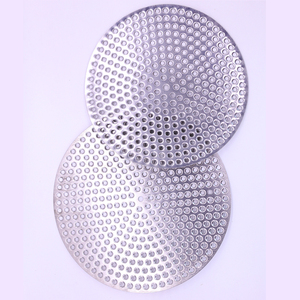
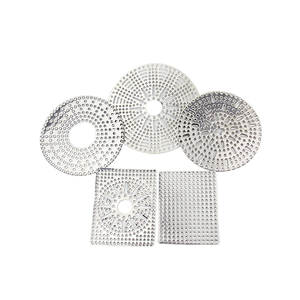
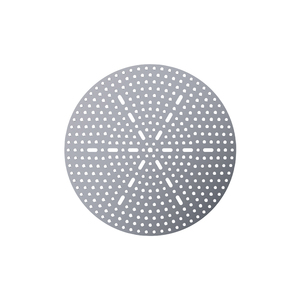
Predominantly applied to cold-forged or die-cast aluminum cookware, perforated SS 430 discs feature strategic punch hole configurations. Under cold high-pressure pressing, soft aluminum flows upward through the perforations, mechanical riveting the plate securely onto the pan bottom.
As European Union energy directives (such as ERP micro-efficiency metrics) and US eco-compliance standards tighten, brand owners and procurement directors must realign their supply chain strategies. Key technological and market shifts include:
Modern pan bottom factories are migrating from standard circular hole matrices to proprietary ray-radial, honeycomb, and Fibonacci spiral perforation patterns. These computer-modeled geometries minimize thermal stress concentration vectors while enhancing magnetic coupling area by up to 18%, yielding faster boiling times.
Rising stainless steel coil costs and freight tariffs drive demand for ultra-thin yet rigid SS 430 discs (0.4mm to 0.5mm). Achieving planarity flat tolerances within ±0.15mm on thin-gauge material requires specialized multi-stage tension leveling during blanking.
Tier-1 OEMs now require full ESG traceability, including Mill Test Reports (MTRs) validating electric arc furnace (EAF) steel origin with reduced carbon intensity, meeting EU Carbon Border Adjustment Mechanism (CBAM) readiness.
The rapid convergence of smart kitchen appliances (electric pressure cookers, air-fryer grills, multi-kadais) requires pan bottoms with integrated temperature sensor recesses and dual gas-induction physical profiles.
Backed by five decades of metallurgical expertise, state-of-the-art tooling infrastructure, and robust dual-facility operational resilience.
We design, cut, and maintain compound progressive dies inside our own tool rooms. OEM buyers benefit from rapid first-article sample turnaround (under 7 days), exact dimensional fidelity to CAD/DXF drawings, and zero third-party tooling markups.
Operating primary stamping plants in major manufacturing hubs backed by secondary surge facilities in Sarigam/Gujarat, our production network easily absorbs Q3–Q4 seasonal volume spikes while protecting delivery timelines.
Every production batch is linked directly to raw coil Mill Test Reports confirming chemical composition (Chromium 16–18%, Nickel <0.75%) and tensile limits, ensuring smooth customs clearing (HS Code 7220.9090 / 7326.9099) and compliance.
Induction hobs operate via electromagnetic resonance that induces heat inside ferromagnetic materials. SS 304 is austenitic (non-magnetic) and cannot efficiently couple with the hob's magnetic field. SS 430 is ferritic, possessing high magnetic permeability while offering 16–18% chromium content for corrosion resistance, food-contact suitability under EN 1.4016, and the required elongation for deep drawing.
Delamination prevention is achieved through strict control of three parameters: 1) Utilizing high-pressure impact bonding friction presses (>2,500 tons) to form true metallurgical alloy interfaces; 2) Ensuring precise planar flatness tolerances (±0.15mm) to eliminate micro-air pockets; and 3) Engineering expansion-relief hole patterns that absorb differential CTE movements during rapid thermal changes (e.g., cold water pouring onto a 220°C pan).
All export orders departing via Ningbo, Shenzhen, or JNPT ports include standard international trade documentation: Certificate of Origin (Form E/FTA where applicable), Mill Test Reports (MTR EN 10204 3.1), Commercial Invoice, Detailed Packing List, and precise HS Classification (HS 7220 9090 for circle blanks, HS 7326 9099 for finished component bases).
For custom geometry or proprietary logo embossing dies, our in-house tool room completes die production within 7 to 12 working days. First-article inspection (FAI) samples, complete with dimensional measurement reports, are shipped immediately for buyer approval prior to mass production release.
Yes. Over 70% of our production volume consists of white-label manufacturing for major international cookware brands, private-label importers, and commercial kitchenware distributors. All custom tooling and branding remain strictly confidential under Non-Disclosure Agreements (NDAs).
Perforations allow soft aluminum to flow through the steel disc for mechanical locking. However, excessive hole open-area reduces the magnetic mass of SS 430, decreasing induction efficiency. Our engineering team calculates the optimal open-area ratio (typically 28%–35%) to balance maximum bond strength with peak magnetic coupling efficiency.
Send us your technical drawings, 3D CAD files, or physical target specifications. Our senior metallurgical engineers will provide a comprehensive DFM (Design for Manufacturability) evaluation and factory-direct quotation within 24 hours.
Contact Us