Choosing Stainless Steel Snack & Dip Platters looks simple until real serving conditions expose the differences. A platter may appear polished online, yet feel unstable when loaded with olives, crackers, fruit, and two thick dips. Experienced buyers inspect more than appearance. They check steel grade, rim strength, surface finish, bowl stability, and cleaning access. These details influence presentation, hygiene, and long-term value.
Dr. Benjamin Chapman, a respected food-safety researcher, offers a useful reminder: “Food safety is a shared responsibility.” His point applies directly to servingware. Stainless steel can resist stains, odors, and corrosion when selected and maintained properly. However, it does not remove the need for careful washing, drying, and sensible food handling. Look for smooth surfaces, secure joins, and removable dip containers without narrow gaps. Those small features matter during busy gatherings.
The right platter should match the occasion, not only the photograph. A compact design suits apartment tables and casual movie nights. Larger divided models work better for family events, receptions, or grazing displays. Consider the food’s weight. Thin crackers need less support than cut fruit, cheese, and chilled sauces. Handles can improve carrying, although they may reduce usable space. That trade-off deserves attention.
No platter is perfect. Even premium steel can show fingerprints, water spots, or scratches. That is not a failure, but it requires realistic expectations. A thoughtful choice balances appearance, safety, capacity, maintenance, and daily practicality. This guide explains how to compare Stainless Steel Snack & Dip Platters with clearer judgment, fewer assumptions, and better results at the table.
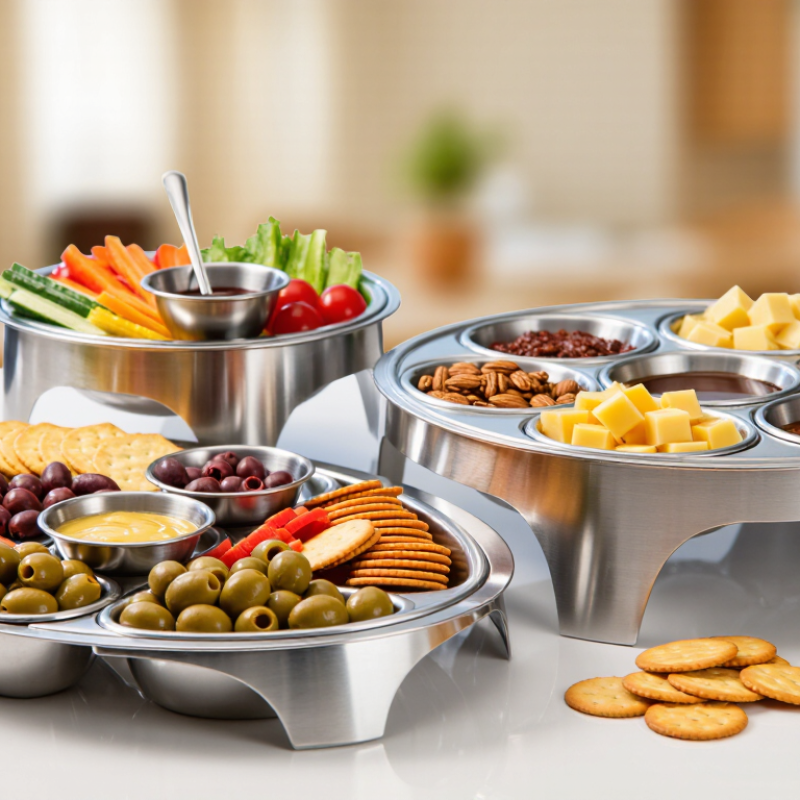
Define Your Serving Needs and Usage Scenarios
Choosing stainless steel snack and dip platters starts with the serving moment, not the finish.
For a family movie night, a compact two-section tray prevents crackers from crowding a small table. For office meetings, choose deeper wells and carry handles; sauces spill quickly during transport. Catering and buffet service usually need stackable shapes, clear portion zones, and a stable base.
The USDA ERS Food Expenditure Series reports that food-away-from-home represented 58.5% of U.S. food spending in 2023.
That shift supports more shared, ready-to-serve occasions, but it does not justify buying oversized trays. Bigger is not always better. I have found that unused space makes snacks look sparse and encourages overfilling.
Match material and construction to actual use. Food-contact stainless steel should be corrosion-resistant, smoothly finished, and free from sharp seams. A 304-grade steel, often described as 18/8 or 18/10, is practical for frequent washing, although grade alone cannot guarantee durability. Check the manufacturer’s care instructions.
The National Restaurant Association’s 2024 State of the Restaurant Industry report projected $1 trillion in U.S. restaurant sales, highlighting the need for servingware that withstands repeated handling.
For home use, dishwasher compatibility and nesting may matter more than commercial thickness. For outdoor service, prioritize weight, wide feet, and covered dip cups.
Test the platter with real portions: six tablespoons of hummus, sliced vegetables, and crackers need different spacing. It is easy to misjudge. A beautiful tray can still feel awkward when one hand carries it and the other opens a door.
Compare Stainless Steel Grades and Surface Quality
When choosing stainless steel snack and dip platters, grade matters more than a mirror-like photograph. For frequent contact with salty dips, 304 stainless steel is a practical baseline. It resists everyday moisture and is usually easy to clean. In coastal kitchens or harsher conditions, 316 offers stronger corrosion resistance because it contains molybdenum. That extra protection may be unnecessary for occasional home serving. Cost still matters. A lower-cost 430 grade can look attractive, but it generally provides less corrosion resistance than 304. Check the product specification, not only the seller’s description.
Surface quality affects hygiene, appearance, and daily handling. Look for an even finish without cloudy patches, deep scratches, pinholes, or sharp edges. Brushed surfaces hide fingerprints better. Polished surfaces reflect more light but show marks quickly. Run a clean fingertip around the rim and inspect the dip wells closely. Welds should be smooth, closed, and free from dark crevices where residue can collect. My early checks were too simple. I once trusted a strong magnet test, but magnetism alone cannot identify stainless steel grade reliably. Ask for thickness, grade, finish details, and care instructions. Avoid platters with vague metal claims or rough, uneven polishing. A glossy surface can still hide poor edges.
Choose the Right Size, Shape, and Compartment Layout
Choosing a stainless steel snack and dip platter starts with the serving situation, not appearance.
For two people, a compact 10- to 12-inch platter usually leaves enough room for sliced fruit, crackers, and one dip bowl. Larger gatherings need a 14-inch or wider surface, especially when snacks should remain separated. Measure your table first. A generous platter can crowd plates and glasses. A shallow rim helps guests reach food, while a raised edge reduces spills during carrying. For heavier foods, choose a thicker base with stable feet or a broad underside.
I once selected a beautiful, oversized tray that became awkward near a crowded buffet. It looked impressive. It was not practical.
Shape changes how food is shared.
Round platters encourage central grazing and work well on small tables. Rectangular designs use narrow counters efficiently and create clear zones for crackers, vegetables, and cheese. Oval shapes offer a softer layout but may waste corner space. Compartment layouts deserve close attention. Two sections suit one snack and one dip; three or four sections support contrasting textures without mixing flavors. Deep compartments hold hummus or salsa more securely, while shallow sections suit dry snacks. Check whether each section is wide enough for serving tongs or a small spoon. Smooth, food-grade stainless steel is easy to inspect and clean, but welded corners can trap residue if poorly finished. Examine the joints in person when possible.
I still reconsider compartment-heavy designs; they organize food neatly, yet they can limit portion size and future uses.
Check Durability, Maintenance Needs, and Overall Value
How to Choose Stainless Steel Snack and Dip Platters
Durability starts with the steel grade, not the shine. Type 304 stainless steel is commonly chosen for food-contact service because it resists corrosion and staining. Type 316 offers stronger resistance in salty or acidic environments, but it usually costs more. The U.S. Food and Drug Administration’s 2022 Food Code requires food-contact surfaces to be corrosion-resistant, nonabsorbent, smooth, and easily cleanable. Check those qualities closely. A decorative finish cannot repair weak welds or sharp edges.
Maintenance affects real value. Look for removable dip cups, rounded corners, and stable feet that do not trap crumbs. Deep scratches can hold residue and become difficult to inspect. The World Stainless Association reported 58.4 million tonnes of crude stainless steel production in 2023, showing the material’s broad industrial use, but production volume does not guarantee product quality. Ask about thickness, dishwasher guidance, and replacement parts. A low-priced platter may become expensive after repeated warping or loose handles. I still inspect each joint by hand; product descriptions often sound better than the metal feels. Use mild detergent, dry the surface promptly, and avoid chlorine-based cleaners unless the manufacturer permits them. Small stains happen. That is not failure, but ignoring them can shorten service life.
304 stainless steel offers the best balance for most snack and dip platters: strong corrosion resistance, easy cleaning, and good long-term value. 316 stainless steel provides higher resistance to salt and acidic foods but usually costs more, while 430 stainless steel is economical and easy to maintain but is less corrosion-resistant.
Conclusion
Choosing the right Stainless Steel Snack & Dip Platters begins with understanding your serving needs and usage scenarios. Consider whether the platter will be used for casual family snacks, parties, catering, or everyday entertaining. Stainless steel grades and surface quality are also important, as high-quality materials can offer better corrosion resistance, a smoother finish, and greater long-term reliability. Select a size, shape, and compartment layout that suits the types of snacks and dips you commonly serve while making the presentation organized and attractive.
Stability, safety, and easy cleaning should also guide your decision. Look for a well-balanced design, secure compartments, smooth edges, and surfaces that are simple to wash and maintain. Finally, evaluate durability, maintenance requirements, and overall value rather than focusing only on the initial price. A thoughtfully designed platter should remain practical, attractive, and dependable through frequent use, providing convenient serving performance for a wide range of occasions.