0%

Choosing China’s top Commercial Round Fryer Baskets requires more than comparing prices or polished product photographs. In busy kitchens, a basket must survive repeated lifting, oil exposure, washing, and sudden temperature changes. Its wire diameter, mesh spacing, handle grip, weld quality, and basket balance directly affect daily workflow. Small details matter.

Industry research supports this practical view. Grand View Research’s Commercial Deep Fryer Market analysis connects market growth with expanding foodservice operations, convenience dining, and equipment replacement demand. Technavio’s commercial fryer market research also highlights efficiency, durability, and operational consistency as important purchasing factors. These trends make basket quality a business issue, not merely an accessory choice. The U.S. FDA Food Code 2022 and NSF/ANSI 4 provide useful reference points for cleanability, food-contact safety, and commercial cooking equipment design. Chinese buyers should also verify current GB requirements and supplier test documentation.

The strongest Chinese manufacturers usually provide stainless steel specifications, dimensional drawings, sample approval, production records, and shipment inspection evidence. Ask whether the basket fits your fryer’s oil tank without scraping the sides. Check whether the handle remains cool enough during normal service. Request material certificates and confirm the grade, especially when suppliers advertise “stainless steel” without details. That happens.

Cost still matters, but the lowest quotation can hide thinner wire, uneven welding, or inconsistent batches. A reliable evaluation should compare total service life, cleaning time, replacement frequency, and supplier responsiveness. This guide examines those factors carefully, while acknowledging one limitation: factory claims require independent verification before large-scale purchasing.
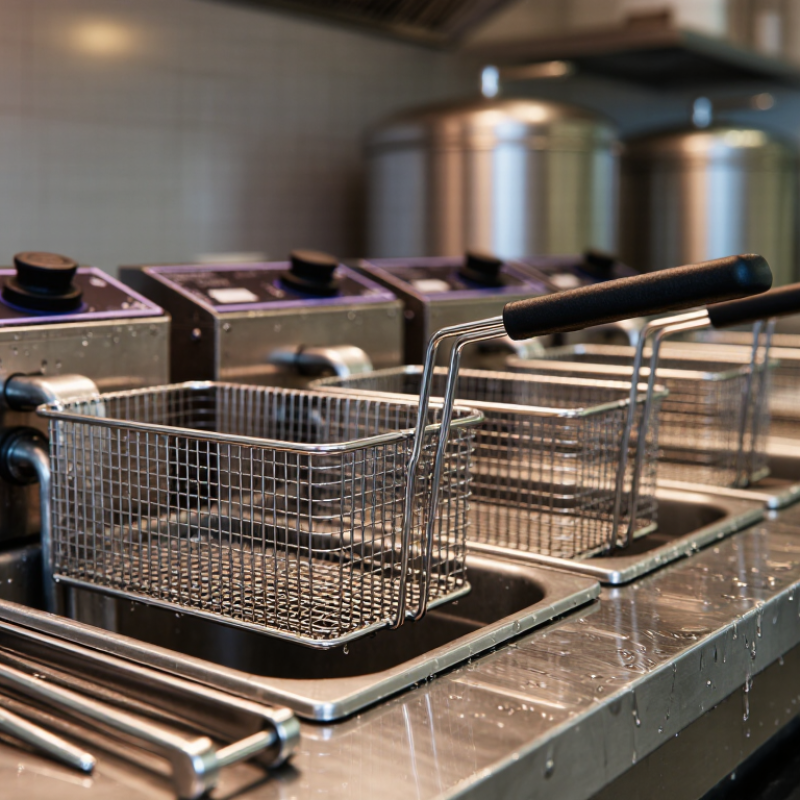
How to Choose China Top Commercial Round Fryer Baskets?

Understanding Commercial Round Fryer Basket Types in China

How to Choose China Top Commercial Round Fryer Baskets?

Understanding basket types is the first practical step. Round fryer baskets usually include wire mesh, perforated metal, and solid-bottom designs.

Wire mesh supports fast oil circulation and suits fries, wings, and small seafood pieces. Perforated baskets reduce product loss while keeping stronger edges. Solid-bottom baskets are less common, but they can hold delicate foods during short frying cycles.

Shape matters.

Commercial kitchens increasingly prioritize efficient equipment. Grand View Research valued the global commercial kitchen equipment market at about USD 37.6 billion in 2022, with continued growth projected through 2030. This trend makes basket efficiency more important.

In China, compare 304 stainless steel, weld quality, handle insulation, and hook strength. Food-contact materials should also match applicable Chinese standards, such as GB 4806 requirements. Ask for material certificates and production inspection records.

Basket diameter must match the fryer pot, not only the advertised capacity. Leave enough clearance for oil movement. A basket that fits too tightly may create uneven frying and difficult lifting.

Check mesh openings with the actual food size. Small shrimp can fall through surprisingly wide mesh.

I once underestimated handle clearance near a fryer lid; it slowed daily cleaning. That mistake was simple, but costly in time.

Also inspect rounded corners, drainage speed, and surface polishing. These details decide whether crumbs collect after repeated batches. A supplier’s sample test is useful, though one test cannot replace long-term durability checks.

Identifying the Right Fryer Basket Size and Capacity

How to Choose China Top Commercial Round Fryer Baskets?
Identifying the Right Fryer Basket Size and Capacity

Choosing a round fryer basket starts with the fryer chamber, not the basket alone. Measure the chamber’s diameter, depth, oil level, and heating-element clearance. Measure the chamber. A basket that fits the opening may still touch the heating area or block oil circulation. Leave room. At least 10 to 15 millimeters of clearance helps prevent scraping during busy service.

Capacity should match the food, not the basket’s advertised volume. A 10-liter basket rarely performs well with 10 liters of raw product. Food needs space to move, and crowded pieces often become pale, greasy, or unevenly cooked. For many operations, loading 50 to 70 percent of the usable basket volume gives more consistent results. Consider product shape, coating, moisture, and expansion. Frozen fries and battered seafood behave differently.

My early sizing estimates were too optimistic. I once focused on maximum load and ignored recovery time after loading. That mistake mattered. A smaller batch can produce faster, more reliable service than an oversized batch. Check the handle position, mesh strength, weld quality, and drainage speed. A rounded base can improve circulation, but it may reduce the basket’s stable standing area. Ask the supplier for exact inner dimensions, empty weight, recommended load, and material specifications. Confirm these details with a sample basket before ordering a large quantity. Measurements should be tested in the actual fryer, during a realistic service period.

How to Choose China Top Commercial Round Fryer Baskets?

Identifying the right fryer basket size and capacity

Larger baskets provide greater batch capacity, but they require a fryer pot with sufficient diameter and oil depth. As a practical selection guide, a 220–280 mm basket is suitable for compact and medium commercial fryers, while baskets measuring 320–360 mm are better for high-volume cooking. Actual food capacity varies by product, coating, moisture level, and the recommended fill line.

Evaluating Materials, Shape, and Heat Resistance

How to Choose China Top Commercial Round Fryer Baskets?

Material affects durability, cleaning, and food contact safety. Stainless steel is a practical choice for busy kitchens. It resists rust and usually tolerates repeated washing. A nickel-plated surface may look smooth, but scratches can expose weaker metal underneath. Check the wire grade, weld quality, and surface finish before ordering. Sharp edges are small details, yet they can damage gloves or catch food particles.

Shape controls cooking results more than many buyers expect. A round basket should sit evenly inside the fryer, without touching the heating area. Tight mesh holds small fries and batter pieces, while wider mesh improves oil circulation for larger foods. Measure the basket diameter, depth, handle length, and hanging position. Handles should stay cool enough for normal service, but actual temperature depends on oil, cooking time, and ventilation. A sample test is worthwhile.

Heat resistance needs more than a high temperature number on a product sheet. Ask for continuous-use data, thermal-shock testing, and weld inspection records. A basket may survive hot oil but deform after sudden cooling. That mistake is easy to make. Place a sample in heated oil, inspect it after several cycles, and check for loose wires or coating changes. Compare supplier documents with your fryer’s operating range and local food-contact requirements. Some specifications seem convincing, but they still need practical verification.

Checking Compatibility with Commercial Fryer Equipment

How to Choose China Top Commercial Round Fryer Baskets?

Compatibility should guide every commercial fryer basket purchase. Measure the fryer vat before reviewing basket dimensions. Check its length, width, depth, and corner shape. A basket that is only 5 millimeters wider may scrape the vat walls. That can damage the coating and restrict oil circulation. Confirm the hook position, handle clearance, and hanging height. The basket must sit securely without touching heating tubes or sensors. According to ENERGY STAR, certified commercial fryers can use about 30% less energy than standard models. Correct basket sizing helps preserve efficient oil movement and stable cooking temperatures.

Material choice also matters. Stainless steel wire should resist repeated contact with hot oil, cleaning chemicals, and daily lifting. Ask for wire diameter, mesh spacing, weld quality, and tested load capacity. Fine mesh suits smaller foods, while wider spacing improves drainage for larger portions. The 2024 NAFEM Foodservice Equipment Market Forecast highlights continued pressure on operators to improve efficiency and control operating costs. A poorly matched basket can increase cooking time and oil loss. I have seen this happen. The specification looked correct, but the handle blocked the fryer lid.

Tips: Send the equipment model, vat drawing, and basket measurements to the manufacturer. Request a sample basket when possible. Test it cold first, then with a normal food load. Check whether two baskets can lift independently. Do not trust a universal-fit claim without measurements. Even a minor mismatch deserves another review.

How to Choose China Top Commercial Round Fryer Baskets? - Checking Compatibility with Commercial Fryer Equipment

Use the fryer manufacturer's equipment specifications as the final reference before ordering replacement or additional baskets.
Compatibility Dimension Common Commercial Basket Data Typical Measurement Range Why It Matters Recommended Checking Method
Basket Shape Round or cylindrical basket Suitable for round fryer wells; diameter commonly 180–300 mm (7.1–11.8 in) A round basket must fit inside the fryer well without touching the heating elements, temperature probe, or tank wall. Measure the usable internal diameter of the fryer well at the basket's lowest operating position.
Overall Basket Height Basket body height excluding the handle Approximately 100–220 mm (3.9–8.7 in) Excessive height may prevent the basket from sitting correctly or may interfere with the fryer lid and heating assembly. Compare the basket body height with the available depth above the oil line and below the lid or splash guard.
Basket Diameter and Clearance Outside diameter including the rim Allow at least 10–15 mm (0.4–0.6 in) total clearance from the tank wall where the fryer design requires free movement Clearance helps prevent scraping, improves oil circulation, and reduces the risk of contact with fixed fryer components. Do not select a basket based only on the nominal fryer capacity; verify the actual opening and internal obstructions.
Basket Capacity Recommended food load rather than total basket volume About 0.5–2.5 kg (1.1–5.5 lb) of food, depending on basket size and product type Overloading lowers oil temperature, increases cooking time, and can cause uneven frying or excessive oil absorption. Match the food load to the fryer recovery capacity and follow the equipment's maximum load instructions.
Fryer Oil Capacity Tank oil volume supported by the fryer Common commercial ranges include 8–25 L (2.1–6.6 US gal) per tank The basket should provide enough clearance for food expansion while remaining stable during lifting and draining. Confirm the basket is intended for the same tank size and oil-fill range as the fryer.
Mesh Opening Woven wire mesh or perforated metal Common openings are approximately 3–8 mm (0.12–0.31 in) Smaller openings retain small food pieces; larger openings improve oil drainage but may allow small products to fall through. Select the opening according to the smallest food piece being fried and the fryer filtration requirements.
Material Food-contact stainless steel or nickel-plated steel Stainless steel is commonly selected for corrosion resistance and repeated commercial use Material affects durability, cleaning performance, resistance to hot oil, and suitability for frequent sanitizing. Request the material grade and confirm that all food-contact surfaces are suitable for hot-oil applications.
Wire or Sheet Thickness Structural wire diameter or perforated-sheet thickness Often approximately 1.5–3.0 mm, depending on the basket design and load requirement Thicker construction generally improves rigidity, but it can add weight and may reduce usable capacity. Choose the construction according to the expected food load, lifting frequency, and cleaning conditions.
Handle Design Fixed, removable, folding, or heat-resistant insulated handle Handle length commonly extends 150–300 mm (5.9–11.8 in) beyond the basket body The handle must keep the operator away from hot oil and must not interfere with adjacent fryer tanks or covers. Check handle clearance, attachment strength, folding position, and whether the handle can be removed for storage or cleaning.
Hanging Hook or Drain Rest Front hook, side hook, or rim-support design Hook position and width must match the fryer rim; no universal dimension applies A compatible drain rest allows oil to return to the tank while keeping the basket secure and balanced. Measure the fryer rim thickness and support location; never assume that a hook will fit every commercial fryer.
Heating Element Clearance Distance between the lowest basket point and fixed or movable heating components Must remain clear throughout insertion, cooking, lifting, and draining Contact with heating elements or temperature sensors can damage the equipment and create a safety risk. Inspect the tank interior and confirm clearance at every operating position before use.
Operating Temperature Hot-oil frying service Commercial frying is commonly performed around 160–190°C (320–374°F), depending on the food product The basket, handle, welds, and finish must remain stable during repeated heating, cooling, and cleaning cycles. Verify the basket is rated for the fryer temperature range and intended for repeated hot-oil contact.
Drainage and Cleaning Open mesh, rounded corners, smooth welds, and accessible surfaces Design should allow oil to drain freely and food residue to be removed without hidden cavities Good drainage supports oil management, while cleanable surfaces help reduce residue buildup and cross-contamination. Inspect welds, joints, corners, and handle connections; avoid sharp edges or difficult-to-clean crevices.
Load Stability Balanced basket with a rigid rim and secure handle connection Basket should remain level when loaded to its recommended capacity An unstable basket can spill hot oil, increase operator risk, and produce uneven cooking. Test the empty and loaded basket on the fryer rim before placing it into hot oil.
Final Compatibility Check Fryer model, tank dimensions, basket support, handle clearance, and operating load All measured dimensions must be confirmed against the equipment specification Commercial fryer openings and internal layouts vary even when the nominal oil capacity is similar. Confirm the fryer model, internal diameter, tank depth, rim support, maximum food load, and heating-element clearance before purchase.

Comparing Quality, Safety Standards, and Supplier Services

Choosing a commercial round fryer basket requires more than checking its price or surface finish. Quality appears in the details. Look for food-contact stainless steel with consistent thickness and strong corrosion resistance. The mesh should hold small food pieces without restricting oil flow. Smooth welds matter because rough edges can trap residue and complicate cleaning.

Safety standards deserve careful attention. Ask for material declarations, heat-resistance test results, and batch traceability documents. Handles should remain stable during lifting and stay cool enough for safe handling with suitable protective equipment. Check the connection between the basket and handle carefully. A loose joint may seem minor during inspection, but it can become dangerous in a busy kitchen. Small tests help. Fill the basket, lift it repeatedly, and inspect the welds afterward.

Supplier service often reveals practical reliability. A dependable supplier should provide samples, clear dimensions, inspection photos, and honest production timelines. Ask how defects are handled and whether replacement parts are available. Packaging also matters; bent rims can arrive after careless transport. I once focused too heavily on polished appearance and ignored handle balance. That choice caused unnecessary adjustment work. My process is better now, though not perfect. Suppliers should welcome technical questions, admit limitations, and record agreed specifications before production. Clear communication reduces surprises more effectively than attractive promises.

FAQS

What are the main types of commercial round fryer baskets?

Common types include wire mesh, perforated metal, and solid-bottom baskets. Wire mesh improves oil circulation for fries, wings, and small seafood. Perforated designs reduce food loss and provide stronger edges. Solid-bottom baskets protect delicate foods during short frying cycles.

How should I choose the basket diameter?

Match the basket diameter to the fryer pot, not only its advertised capacity. Leave clearance for oil movement and easy lifting. A tight basket can cause uneven frying. Measure the rim, depth, handle space, and lid clearance carefully.

What mesh opening is suitable?

The opening should suit the actual food size. Small shrimp may fall through surprisingly wide mesh. Test representative food pieces before ordering. I once trusted general measurements too much. That was not ideal.

Which materials should I inspect?

Choose food-contact stainless steel with consistent thickness and strong corrosion resistance. Confirm the material meets applicable food-contact standards. Request material certificates and production inspection records. Appearance alone proves very little.

Why are welds and edges important?

Smooth welds reduce residue collection and simplify cleaning. Rough edges can trap crumbs or cause handling injuries. Check rounded corners, polished surfaces, and the basket-to-handle connection. Small defects become troublesome after repeated batches.

How can I test handle safety?

Fill the basket with a realistic load and lift it repeatedly. Inspect the welds, joint, balance, and hook afterward. The handle should remain stable and suitable protective equipment should be used. Test it properly.

What supplier documents and services should I request?

Ask for samples, exact dimensions, inspection photos, material declarations, and realistic production timelines. Confirm batch traceability and defect-handling procedures. Ask whether replacement parts are available. Written specifications reduce unexpected changes.

How does packaging affect basket quality?

Poor packaging can bend rims during transport. Request protective packaging for handles, hooks, and circular edges. Inspect the basket immediately after delivery. A polished finish cannot correct a damaged rim.

Conclusion

Choosing the right Commercial Round Fryer Baskets in China requires careful evaluation of basket type, size, capacity, and intended cooking applications. Buyers should first determine whether they need a standard round basket, a divided design, or a customized option for different food portions. The basket’s dimensions and holding capacity must match daily production needs while allowing enough space for even frying and safe handling. Materials such as stainless steel should be assessed for durability, corrosion resistance, and heat tolerance, while the shape, mesh structure, handle design, and welding quality also influence performance and cleaning convenience.

Compatibility with existing commercial fryer equipment is equally important. Before purchasing, confirm the basket diameter, hook position, depth, and lifting mechanism. Reliable suppliers should provide consistent manufacturing quality, clear product specifications, safety-focused construction, and responsive after-sales support. Comparing samples, inspection procedures, packaging, lead times, and customization services can help businesses select Commercial Round Fryer Baskets that deliver stable performance, long service life, and efficient daily operation.


Ethan

Ethan

Ethan is a highly experienced marketing professional dedicated to helping businesses make informed decisions through clear, practical, and industry-focused content. With a strong understanding of the company’s products, services, and customer needs, he regularly contributes expert articles to the......