Choosing the best China supplier for Tri-Ply Cookware Components requires more than comparing factory prices. It requires evidence, process control, and practical product experience. Tri-ply construction normally combines stainless steel, an aluminum heat-conducting core, and another stainless-steel layer. Each layer affects heating speed, durability, weight, and corrosion resistance.
Market demand supports closer supplier evaluation. Fortune Business Insights estimates that the global cookware market was valued at about USD 19 billion in 2023 and will continue growing through 2032. Grand View Research also identifies stainless steel as a major cookware material because of its durability, hygiene, and compatibility with modern cooking surfaces. These reports show opportunity, but they do not prove that every Chinese manufacturer delivers consistent components. That assumption needs testing.
A reliable manufacturer should provide material certificates, dimensional tolerances, bonding-process records, and batch traceability. Buyers should inspect core thickness, surface finish, flatness, and resistance to delamination. A sample may look perfect under showroom lighting. Production performance is different. Independent testing under thermal cycling can reveal weak bonding or uneven expansion. Small details matter, such as a clean edge after deep drawing or stable contact with an induction hob.
Experience also matters. Manufacturers supplying pressure cookers, frying pans, or commercial kitchen equipment may understand forming stresses better than general metal processors. However, “best” depends on your specification, target market, order volume, and compliance requirements. A factory with excellent equipment may still communicate poorly. That is often overlooked. This guide examines China’s leading Tri-Ply Cookware Components manufacturers through capability, quality evidence, customization, lead time, and long-term reliability.
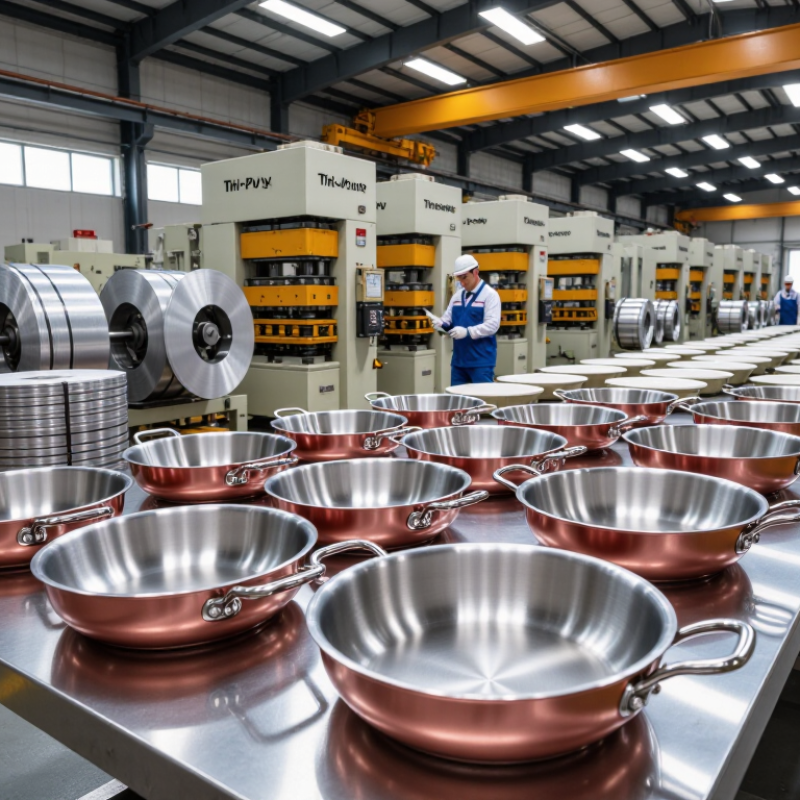
What are tri-ply cookware components? A tri-ply body normally combines three bonded layers: stainless steel inside, an aluminum core, and stainless steel outside. The cooking surface resists corrosion and preserves food flavor. The aluminum core spreads heat faster than stainless steel alone. The exterior supports durability and induction compatibility when magnetic stainless steel is selected.
Grand View Research valued the global cookware market at approximately USD 20.6 billion in 2023.
Its report also projects about 6.3% compound annual growth through 2030. These figures show rising demand, but market growth does not prove component quality. In production, I check layer bonding, core thickness, surface flatness, and edge sealing. Small defects can create hot spots or visible separation after repeated heating.
A thicker core is not automatically better. Weight, forming performance, and heat response must remain balanced. Some suppliers describe three layers loosely, although their aluminum may cover only the base. That is not the same as fully clad tri-ply construction.
Independent testing should confirm thickness, bonding strength, thermal distribution, and material grades. I would also review batch records, because one successful sample cannot represent stable manufacturing. The cookware should feel even in the hand, without sharp rims or distorted bases.
China Best Tri-Ply Cookware Components Manufacturer?
Tri-ply cookware begins with a material decision, not a marketing label. A common structure uses stainless steel inside, aluminum in the middle, and magnetic stainless steel outside. The inner layer supports food contact and corrosion resistance. The aluminum core spreads heat quickly across the base and sidewalls. The outer layer supports induction compatibility.
According to the International Aluminium Institute, recycled aluminum requires about 5% of the energy used for primary production. This figure influences responsible component sourcing. The World Stainless Association reported global stainless steel production of about 58.4 million tonnes in 2023. These figures show why material traceability matters. Yet, material choice alone does not ensure quality.
Manufacturing usually starts with cutting metal sheets into precise blanks. Several layers are then bonded through pressure, heat, or impact forming. Deep drawing shapes the body without separating the layers. Workers trim the rim and machine the base. They also inspect layer bonding, wall thickness, flatness, and surface defects. Thermal tests measure heating speed and temperature balance. EN 12983-1 and related food-contact requirements provide useful technical references.
Small errors can become visible during cooking. A slightly uneven base may wobble on glass or induction surfaces. Excessive polishing can thin the rim. Weak bonding can create hidden separation after repeated heating. This is where specifications need honest review. Experienced manufacturers should keep batch records, test samples, and supplier certificates. Perfect production is difficult. Consistent control is achievable.
High-quality tri-ply cookware begins with a carefully matched material structure. The inner cooking surface usually uses food-grade 304 stainless steel. It resists corrosion and does not easily react with acidic foods. The middle layer commonly uses aluminum because it transfers heat quickly. This helps reduce hot spots beneath delicate sauces. The exterior often uses magnetic stainless steel, such as 430 stainless steel, for induction compatibility and durability.
Material selection alone cannot guarantee reliable performance. The three layers must be bonded evenly across the entire cooking surface. Uneven bonding may create weak areas, warping, or slower heat response. In practical production, experienced engineers inspect layer thickness, surface flatness, edge finishing, and bonding strength. They also check samples after heating and cooling cycles. Small flaws remain.
A thicker aluminum core is not automatically better. Excessive thickness can increase weight and slow handling. A well-balanced construction often performs better than a heavier design. The stainless steel interior should be smooth, clean, and free from deep polishing marks. The outer layer should resist staining and maintain stable contact with the cooktop. Reliable component manufacturers document material grades and conduct repeatable quality checks. Still, every specification deserves review. Cooking habits, pan size, and heat source can change the ideal structure. That practical detail is easy to overlook.
| Cookware Component | Preferred Material | Typical Specification | Primary Function | Quality Indicators | Manufacturing Considerations |
|---|---|---|---|---|---|
| Cooking Surface | Food-contact stainless steel, commonly 304 stainless steel | 18% chromium; nickel content may be included in 18/8 or 18/10 grades | Provides a corrosion-resistant, non-reactive surface for cooking | Smooth interior, uniform finish, no pinholes, stains, or exposed aluminum | Requires consistent forming, polishing, cleaning, and passivation where applicable |
| Heat-Conducting Core | Aluminum | Thermal conductivity is approximately 205–237 W/m·K for common aluminum grades at room temperature | Spreads heat quickly and reduces localized hot spots | Continuous core with even thickness and strong bonding to both stainless layers | Core thickness is commonly adjusted according to pan size, weight, heating response, and cost targets |
| Premium Heat Core Option | Copper | Thermal conductivity is approximately 390–400 W/m·K at room temperature | Offers faster heat response and excellent temperature control | Uniform copper layer, reliable bonding, and complete stainless encapsulation | Higher material cost and density require careful lamination, forming, and weight control |
| Exterior Layer | Magnetic stainless steel, commonly 430 stainless steel for induction compatibility | Typical chromium content is about 16–18%; magnetic behavior supports induction heating | Protects the core and allows the cookware to work on induction cooktops | Flat base, stable magnetic response, corrosion-resistant finish, and no delamination | Base flatness and thickness must be controlled to reduce warping during heating and cooling |
| Alternative Exterior Layer | 304 stainless steel | Non-magnetic or weakly magnetic in its annealed condition | Provides corrosion resistance and a consistent stainless-steel appearance | Suitable where induction performance is not required or where a separate magnetic disc is used | Induction compatibility should be verified through the complete base design, not by appearance alone |
| Bonding Interface | Metallurgically bonded stainless steel and aluminum or copper layers | Full-surface bonding rather than isolated spot attachment | Transfers heat efficiently and prevents layer separation during repeated use | No visible gaps, bubbles, edge separation, or audible movement between layers | Bonding pressure, temperature, surface preparation, and rolling parameters need process control |
| Pan Body | Three-layer stainless steel–aluminum–stainless steel construction | Continuous clad structure extending across the cooking body; some designs also include a bonded base disc | Combines food safety, heat distribution, durability, and compatibility with multiple cooktops | Consistent wall thickness, stable geometry, balanced weight, and uniform heating behavior | Deep drawing, trimming, welding, polishing, and dimensional inspection must be coordinated |
| Rim and Pouring Edge | Formed stainless steel with a fully enclosed laminate edge | Rolled or reinforced rim with no exposed core material | Improves durability, pouring control, and resistance to moisture entering the laminate | Clean edge profile, secure closure, no sharp burrs, and no visible aluminum exposure | Edge forming must maintain the integrity of the bonded layers after trimming and polishing |
| Handle Attachment Area | Stainless steel handle brackets, rivets, or welded fittings | Attachment method selected according to pan weight, handle design, and intended use | Provides secure handling and transfers load from the cookware body to the handle | Rigid attachment, smooth internal rivet surfaces, and no looseness after load testing | Attachment points should be positioned to avoid distortion of the tri-ply wall and cooking surface |
| Lid | Stainless steel or tempered glass with stainless steel fittings | Tempered glass is heat-treated safety glass designed for improved thermal-shock resistance | Retains heat and moisture while allowing visibility when glass is used | Secure fit, smooth rim, stable knob, and resistance to ordinary thermal cycling | Lid diameter, rim geometry, venting, and handle temperature should be checked for compatibility |
| Surface Finish | Brushed, satin, mirror-polished, or electro-polished stainless steel | Finish selected according to appearance, cleaning requirements, and production capability | Improves visual quality and can reduce the visibility of minor marks | Uniform grain or reflectivity, consistent color, and absence of scratches or polishing waves | Finishing should be performed after forming when possible to maintain consistent surface appearance |
| Quality-Control Checks | Material certificates, dimensional inspection, bond testing, and cooking-performance tests | Verification may include alloy identification, thickness measurement, flatness, and heat-distribution testing | Confirms that the cookware meets its intended performance and durability requirements | Traceable inspection records and acceptance criteria defined before production | Testing should cover raw materials, in-process bonding, finished cookware, and representative production samples |
China’s cookware supply chain is extensive, but scale alone proves little. The World Stainless Association reported 58.4 million tonnes of global crude stainless steel production in 2023. This supports material availability, not automatic quality. Buyers should request heat numbers, mill certificates, and traceability records for every production batch.
A reliable manufacturer should explain its tri-ply structure clearly. Ask whether the inner layer uses 304 stainless steel, how thick the aluminum core is, and whether the exterior suits induction cooking. Independent testing can verify layer thickness, bonding strength, flatness, and heat distribution.
Grand View Research estimated the global cookware market at nearly USD 20 billion in 2023, with continued growth expected through 2030. That pressure may encourage faster production, sometimes too fast.
Visit the factory if possible. Watch how sheets are formed, polished, washed, and inspected. Check whether operators measure wall thickness during production, rather than only before shipment. Request samples from different batches. Compare handle alignment, rim smoothness, surface marks, and warping after heating.
Ask for food-contact compliance documents applicable to the destination market. ISO 9001 certification helps, but it does not replace product testing. My own caution is simple: a polished sample can hide inconsistent control. One inspection is not enough. Require corrective-action records, retention samples, and realistic tolerances in the contract.
When buyers evaluate a tri-ply cookware components manufacturer, quality begins with traceable materials. A reliable supplier should identify each metal grade, thickness, and production batch. Stainless steel surfaces need consistent forming, clean welds, and stable dimensions. The aluminum core should spread heat evenly without visible gaps or warping. Copper may improve responsiveness, but its value depends on correct bonding and application. Ask for material certificates, inspection records, and samples from current production. Samples matter. A polished prototype can hide process weaknesses.
Expected standards should cover flatness, layer bonding, edge finishing, hardness, and resistance to repeated heating. Buyers should request practical test data, not only attractive specification sheets. Useful checks include thermal cycling, dishwasher exposure where relevant, handle-load testing, and surface inspection under strong light. Food-contact compliance must have current, verifiable documentation for the destination market. Factory audits can reveal calibration habits, operator training, and defect-handling methods. In my experience, response speed is useful, but honest corrective action matters more. No process is perfect. The supplier should admit limits and explain prevention steps.
Tips: Define tolerances before ordering, approve a sealed reference sample, and record every change in writing. Confirm lead times, replacement policies, packaging protection, and technical support after delivery. A dependable service team reports delays early and answers with evidence. Still, buyers sometimes overvalue low prices and overlook inspection costs. That mistake can return through uneven bases, rejected batches, or costly rework.
Tri-ply cookware usually has three bonded layers: stainless steel inside, an aluminum core, and stainless steel outside. The interior resists corrosion and helps preserve food flavor. The aluminum core spreads heat faster than stainless steel alone. The exterior can improve durability and induction compatibility when magnetic stainless steel is used.
No. Some products have aluminum only across the base. Fully clad construction extends the core through the cookware walls. Buyers should verify cross-sections and supplier test data. A simple label may not tell the whole story.
Aluminum distributes heat quickly and reduces uneven cooking. It can help limit hot spots during heating. However, a thicker core is not automatically better. Weight, forming performance, and heat response must stay balanced.
Request tests for layer thickness, bonding strength, flatness, thermal distribution, and material grades. Check the cookware under strong light. Look for gaps, warping, rough edges, and surface marks. Small defects may become serious after repeated heating.
Ask for material certificates, inspection records, batch information, and current food-contact compliance documents. The documents should match the destination market. Confirm that records come from current production. One attractive sample proves very little.
Samples reveal forming quality, edge finishing, surface flatness, and dimensional stability. A polished prototype may hide process weaknesses. Request samples from a current manufacturing batch. Even then, sampling has limits and needs independent verification.
A dependable supplier should provide technical support, clear lead times, replacement policies, and protected packaging. The team should report delays early. Honest corrective action matters more than fast replies. Perfect production is unlikely.
Define tolerances before ordering and approve a sealed reference sample. Record every design or material change in writing. Review batch records and inspection results. Low prices can look attractive, but rejected batches may cost more later.
They are useful for checking calibration, operator training, and defect-handling practices. Consider thermal cycling, dishwasher exposure where relevant, handle-load testing, and surface inspection. Repeated tests reveal stability better than one successful sample. Testing still cannot remove every uncertainty.
Tri-Ply Cookware Components are engineered layers that combine durability, heat responsiveness, and reliable cooking performance. A typical structure bonds an efficient heat-conducting core between stainless steel surfaces, creating balanced heat distribution while maintaining strength, corrosion resistance, and a practical cooking finish. Their design and manufacturing process involves precise material selection, controlled forming, secure layer bonding, edge treatment, and thorough inspection to ensure consistency across different cookware sizes and shapes.
When evaluating China-based Tri-Ply Cookware Components manufacturers, buyers should assess production capabilities, technical expertise, material traceability, dimensional accuracy, and customization support. High-quality suppliers should provide clear specifications, stable batch performance, sample approval, and effective communication throughout development and production. Buyers should also expect appropriate quality management procedures, performance testing, packaging support, and dependable after-sales service. A capable manufacturer should combine advanced equipment, skilled workmanship, and flexible cooperation to deliver components that meet functional requirements and support long-term cookware production.