0%

Choosing the right supplier for Multi-Kadai Stainless Steel Inserts requires more than comparing prices. It requires practical knowledge of kitchen use, metal quality, and production consistency. A reliable insert should fit tightly inside the kadai without wobbling. Its rim should feel smooth, not sharp. Its base should remain stable during repeated heating and washing.

Ravi Mehta, a stainless-steel cookware sourcing specialist, says, “A good insert is judged by its daily performance, not its showroom shine.” This view matters when evaluating suppliers from China. Buyers should examine stainless-steel grades, commonly 304 or 430, and confirm whether the stated material matches inspection results. Thickness also deserves attention. Thin walls may reduce shipping costs, but they can dent during stacking or commercial use. Too much thickness can increase weight without improving cooking results.

Small details reveal manufacturing discipline. Check the welds, handle joints, polishing marks, and nesting accuracy. Ask for samples before approving bulk production. Request material certificates, food-contact documentation, and clear tolerance data. These documents do not replace physical testing. They support it.

The best supplier should explain these points clearly. That is not always the cheapest supplier. Sometimes, product photographs hide uneven edges or weak handles. This remains a common risk. I would also question overly perfect claims, because real production can involve minor variation. Careful buyers should test heat distribution, cleaning resistance, and repeated fitting. A dependable China supplier combines technical control, honest communication, and useful customization. That combination creates Multi-Kadai Stainless Steel Inserts suited to restaurants, wholesalers, and demanding household kitchens.
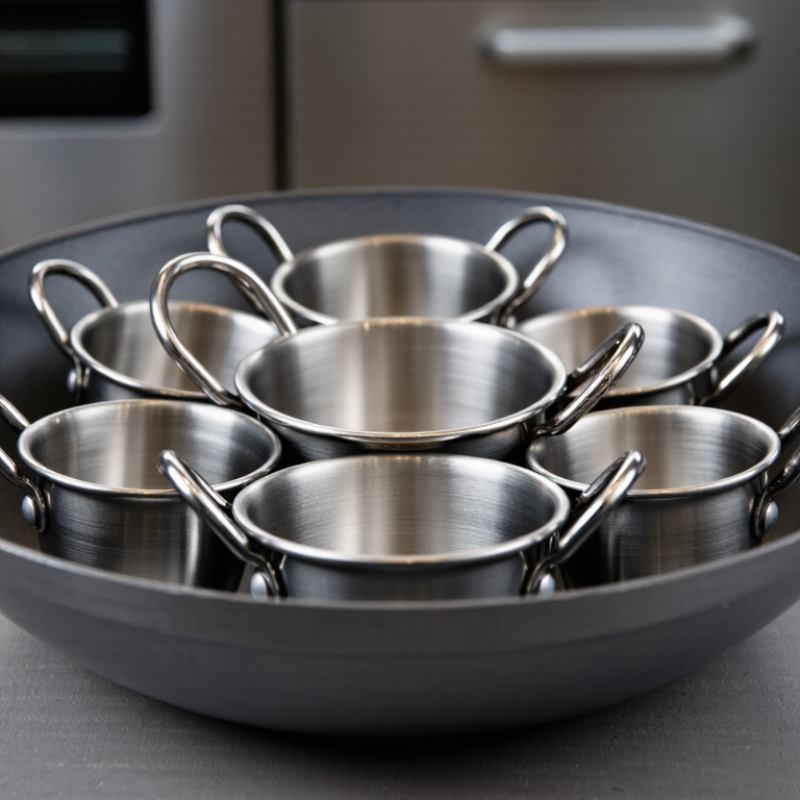
China Best Multi Kadai Stainless Steel Inserts Supplier?

What Is a Multi Kadai Stainless Steel Insert?

A multi kadai stainless steel insert is a removable cooking vessel designed to fit inside a larger kadai or countertop cooking system. It usually has a rounded base, perforated tray, or divided compartments, depending on the cooking task. The insert can steam dumplings, warm sauces, fry small batches, or separate ingredients during preparation. Stainless steel is chosen for corrosion resistance, easy cleaning, and repeated heating. Not every insert performs equally. Thin metal may warp, while rough edges can trap food and complicate washing. In product evaluations, a stable rim and smooth welds matter as much as the steel grade.

For buyers comparing suppliers in China, the insert should match the actual kadai dimensions, not only a catalog drawing. Measure the inner diameter, depth, rim width, and heat-source clearance. A few millimeters can affect balance and airflow. Food-contact surfaces should be easy to wash and free from sharp burrs. Ask for a sample before approving bulk production.

Test it with water, oil, and repeated heating. Observe discoloration, loose handles, and whether the insert remains level. Small holes may steam quickly. They can also block with starch or spices. This is where assumptions fail. Confirm packaging too, because dented rims can make a sound insert unusable. Clear inspection records improve supplier reliability, although one sample cannot predict every kitchen condition.

Key Features and Benefits of Stainless Steel Inserts

China Best Multi Kadai Stainless Steel Inserts Supplier?

Stainless steel inserts make a multi kadai more flexible for steaming, simmering, and portioned cooking. A 304 stainless insert offers strong corrosion resistance for everyday kitchen use. A 316 grade can perform better in salty or chloride-rich environments. The choice should match the cooking conditions.

The International Stainless Steel Forum reported 58.4 million tonnes of crude stainless steel production in 2023. This scale reflects stainless steel’s importance across food equipment and processing. Still, material volume does not guarantee quality. Buyers should check ASTM A240 compliance, measured thickness, smooth welds, and stable dimensions. A thin insert may look bright but warp over direct heat.

Cleanability matters just as much. NSF/ANSI 2 focuses on food equipment materials, construction, and cleanable surfaces. Inserts should have rounded corners, even polishing, and no crevices around handles. These details reduce trapped food residue after washing. In practical inspections, a simple fingertip check can reveal rough welds. It is not a laboratory test, but it catches careless finishing.

Stacking accuracy also affects daily use. Poorly matched inserts may scrape, tilt, or block steam movement. A reliable supplier should provide sample measurements, steel grade documentation, and production inspection records. I would not rely on photographs alone. Even good stainless steel can disappoint when the lid fit, wall thickness, or drainage design is overlooked.

How Multi Kadai Inserts Are Manufactured in China

China’s multi kadai stainless steel inserts begin with material control, not polishing. World Stainless reported about 58.4 million tonnes of crude stainless steel production worldwide in 2023. This scale supports broad sourcing, but volume does not guarantee consistency.

Manufacturers usually select food-contact stainless steel, often 304 for balanced corrosion resistance. Incoming coils are checked for thickness, surface marks, and grade documentation. A blanking press cuts each disc. Deep-drawing machines then shape the insert gradually. Excessive pressure can create wrinkles or thin the base. That is where experience matters.

The formed insert may receive trimming, edge rolling, annealing, and mechanical polishing. Workers inspect the rim by touch. It should feel smooth, without sharp points or abrasive lines. Dimensional checks cover diameter, depth, wall thickness, and nesting fit. Sampling can follow ISO 2859-1 procedures, while chemical verification should match the declared material grade. Leak testing is also practical for perforated or fitted designs.

According to the World Stainless 2023 production data, stainless supply remains substantial, yet mills and batches can vary. A reliable supplier should preserve heat numbers, inspection records, and corrective-action reports. Ask for samples from regular production, not only selected showroom pieces. No factory is flawless. Even a careful process can miss a small distortion, especially after polishing. Reviewing rejected parts often reveals more than viewing perfect samples.

China Best Multi Kadai Stainless Steel Inserts Supplier? How Multi Kadai Inserts Are Manufactured in China

Multi kadai stainless steel inserts are commonly produced through coil or sheet cutting, deep drawing, trimming, edge forming, polishing, cleaning, inspection, and final packing. The chart compares representative chromium and nickel content for stainless steel grades frequently selected for food-contact cookware. Actual chemistry may vary within the applicable material standard.

Chromium supports corrosion resistance by forming a passive surface layer, while nickel improves toughness, formability, and resistance to many food acids. Grade 304 is widely used for general cookware, grade 316 offers enhanced corrosion resistance, and grade 430 is a lower-nickel ferritic option often selected for cost-sensitive applications.

How to Evaluate a Reliable Chinese Supplier

China Best Multi Kadai Stainless Steel Inserts Supplier?

Choosing a reliable Chinese supplier requires more than comparing prices. A polished website proves very little. Request a factory video, business registration details, and recent production photographs. Check whether the supplier actually manufactures stainless steel inserts or only resells them. Ask for material certificates, especially for food-contact grades such as 304 stainless steel. Confirm thickness, diameter, handle design, and compatibility with your kadai before ordering.

Tips: Start with a paid sample. Inspect its welds, edges, surface finish, and fit. Place the sample on a level pan. It should sit firmly without sharp points or visible gaps. Ask how rejected pieces are handled. Clear answers matter.

Reliable suppliers explain production controls without avoiding difficult questions. Request inspection records, packaging details, and a written tolerance range. Small differences can affect stacking and heating performance. Confirm carton strength through a drop-test video or sample shipment. Communication also reveals experience. A professional team answers technical questions directly and reports limitations honestly. Vague promises are warning signs. One common mistake is judging quality from one attractive sample. Batch consistency matters more. Request samples from different production runs when possible. Review payment terms, lead times, replacement procedures, and shipping documents before placing a larger order. Even careful checks can miss problems. Recheck the first shipment before approving repeat production.

Applications, Customization, and Quality Standards

China’s multi kadai stainless steel inserts serve buffets, catering lines, hotel kitchens, and institutional foodservice. The World Stainless Association reported 58.4 million tonnes of crude stainless steel production in 2023. This scale supports broad sourcing options, but volume does not guarantee consistency. Buyers should verify 304 or 316 material grades through mill test certificates. Real kitchens expose weak welds quickly.

Customization should match the cooking workflow. Common options include 1/2 or 1/3 pan sizes, varied depths, reinforced rims, drain holes, and polished interiors. Suppliers can also adjust handles and stacking clearance. For food-contact use, surfaces should be smooth, corrosion-resistant, non-absorbent, and easy to clean, as required by the FDA Food Code 2022. NSF/ANSI 2 is another useful reference for commercial food equipment. Still, paperwork alone is not enough. A sample inspection may reveal sharp edges, uneven bases, or poor passivation.

Tips: Ask for material certificates, weld photos, dimensional drawings, and a pre-shipment inspection. Test nesting and lid fit with actual kitchen racks. Request salt-spray or corrosion evidence when acidic foods are common. A small weakness matters. It may become a cleaning problem later. Also, avoid choosing only by price; this is an easy mistake, though budget pressure is real.

China Best Multi Kadai Stainless Steel Inserts Supplier? - Applications, Customization, and Quality Standards

Evaluation Dimension Recommended Specification Typical Applications Customization Options Quality Verification
Primary Material Food-contact stainless steel, commonly AISI 304; AISI 316 may be selected for higher corrosion resistance. Commercial kitchens, catering operations, buffet service, hotels, and household cooking. Material grade, surface finish, brushed or mirror polishing, and decorative exterior treatment. Material certificate, alloy identification, visual inspection, and food-contact compliance documentation where required.
Insert Configuration Multi-insert systems with two, three, four, or more removable cooking containers. Preparing several dishes simultaneously, portion control, serving stations, and meal preparation. Number of inserts, divided compartments, insert depth, matching lids, handles, and support frames. Dimensional inspection, fit testing, stability testing, and verification of removable-part interchangeability.
Common Insert Sizes Typical food-service formats include full-size, half-size, and third-size pans; exact dimensions should be confirmed before ordering. Steam tables, chafing dishes, buffet counters, hot holding equipment, and prep areas. Custom length, width, depth, corner radius, perforation pattern, and compatibility with existing equipment. Caliper or gauge measurement, go/no-go gauges, corner-radius checks, and equipment compatibility trials.
Material Thickness Often selected within approximately 0.6–1.2 mm, depending on size, forming method, load, and intended use. Light-duty household use, frequent commercial service, and heavy-duty catering applications. Different thicknesses for inserts, lids, frames, handles, and reinforced rims. Thickness mapping at multiple points, flatness inspection, edge-strength checks, and load testing.
Heating Compatibility Compatibility depends on the base construction; stainless steel is generally suitable for gas and electric cooking, while induction requires a magnetic base. Gas stoves, electric cooktops, induction cooktops, ovens, steam tables, and warming units. Encapsulated base, bonded magnetic plate, heat-diffusion layer, and oven-safe handle selection. Heating uniformity test, base flatness test, induction recognition test, and thermal cycling.
Handle and Lid Design Secure, heat-resistant handles and fitted lids with practical clearance for steam release. Cooking, transport, hot holding, storage, and buffet presentation. Handle shape, riveted or welded attachment, lid type, vent hole, stacking feature, and removable components. Pull-force testing, torque testing, sharp-edge inspection, lid-fit inspection, and heat-resistance evaluation.
Surface Finish Smooth, non-porous surfaces with consistent polishing and no exposed burrs, pits, or contaminating residues. Food preparation and service environments where cleaning efficiency and appearance are important. Mirror finish, satin finish, brushed finish, laser markings, and controlled branding-free markings. Surface appearance inspection, roughness checks when specified, passivation review, and burr inspection.
Cleaning and Hygiene Detachable inserts and smooth welded or formed surfaces that support manual or commercial cleaning. Restaurants, institutional kitchens, food processing support areas, and high-turnover catering. Dishwasher-safe construction, rounded corners, drainage features, stackable geometry, and easy-grip rims. Cleanability review, weld inspection, detergent-resistance testing, and corrosion observation after repeated washing.
Food-Contact Compliance Documentation should match the destination market and the exact material, coating, solder, and accessory configuration. Domestic retail, food-service distribution, export projects, and institutional procurement. Market-specific declarations, test reports, packaging labels, instruction sheets, and traceability records. Review of applicable food-contact regulations, migration testing when required, and batch traceability.
Packaging and Logistics Protective separation for polished surfaces, moisture control, carton strength, and efficient nesting. Bulk import, distributor supply, retail packaging, and project-based kitchen installation. Carton dimensions, inserts, barcode labels, neutral packaging, pallet configuration, and shipping marks. Drop testing, carton compression testing, quantity verification, packing-list review, and pre-shipment inspection.
Supplier Selection Indicators A capable supplier should provide stable specifications, clear tolerances, consistent samples, documented inspections, and responsive engineering support. Private-label projects, custom kitchen equipment, replacement inserts, and recurring wholesale orders. Technical drawings, prototypes, sample approval, controlled revisions, production audits, and inspection plans. Factory audit records, quality-control procedures, corrective-action reports, sample-to-production comparison, and final inspection data.

FAQS

What is a multi kadai stainless steel insert?

It is a removable vessel placed inside a larger cooking kadai. It may steam, warm, fry, or separate ingredients. Some models include perforated trays or divided sections.

What should buyers measure before ordering?

Measure the inner diameter, depth, rim width, and heat-source clearance. A few millimeters can affect balance. Use the actual kadai, not only a catalog drawing.

Which stainless steel details matter most?

Check the material grade, thickness, weld quality, and surface finish. Food-contact surfaces should be smooth and corrosion-resistant. Thin metal may warp during repeated heating.

How can I test a supplier’s sample?

Fill it with water and test it with oil. Heat it repeatedly and place it on a level pan. Check for wobbling, discoloration, loose handles, and sharp edges.

How can I identify a reliable supplier?

Request factory evidence, registration details, production photographs, and material certificates. Ask whether the supplier manufactures the insert directly. Vague answers deserve caution.

What customization options are commonly available?

Suppliers may adjust pan sizes, depths, handles, drain holes, and stacking clearance. Common formats include half-size and one-third-size pans. Confirm every measurement in writing.

Why are welds, rims, and packaging important?

Rough welds can trap food and make cleaning difficult. A weak rim may bend during stacking. A dented package can ruin a usable insert.

Are documents and one sample enough?

No. One attractive sample cannot prove batch consistency. Request inspection records and samples from different production runs. Recheck the first shipment. Mistakes can still happen.

Conclusion

Multi-Kadai Stainless Steel Inserts are practical cooking components designed to fit multi-compartment kadai cookware, helping users prepare several dishes, sauces, or ingredients at the same time. Made from food-grade stainless steel, these inserts typically offer strong corrosion resistance, easy cleaning, good heat tolerance, and long service life. Their smooth surfaces and secure fit also support safer, more organized cooking in homes, restaurants, catering operations, and commercial kitchens.

China has become an important manufacturing base for stainless steel inserts because suppliers can provide flexible production, efficient processing, and competitive pricing. Manufacturing commonly includes material selection, precision cutting, forming, welding, polishing, and dimensional inspection. When evaluating a supplier, buyers should review stainless steel quality, product consistency, production capacity, customization options, packaging, and quality-control procedures. Reliable suppliers should also support sample approval, logo or size customization where appropriate, and compliance with applicable food-contact and international quality standards.


Amelia

Amelia

Amelia is a professional marketing specialist with a strong understanding of product strategy, customer needs, and digital communication. As a core member of the company’s marketing team, she combines market research, industry insight, and clear storytelling to help audiences better understand the......