Choosing the right idli plate can change a simple breakfast into a smoother kitchen routine. The best Stainless Steel Idli & Steamer Plates should heat evenly, release idlis cleanly, and tolerate repeated washing. They should also fit securely inside your available steamer or pressure cooker.
Dr. Meera Nair, an independent culinary-equipment consultant, says, “A dependable idli plate should release cleanly, heat evenly, and survive ordinary neglect.” That practical standard guides this review of seven popular options. Each plate deserves attention beyond its polished surface. Metal thickness, cup depth, handle design, welding quality, and spacing can affect daily results. Small details matter.
Look closely at the cooking experience. Thin steel may heat quickly, yet it can warp after frequent use. Deeper molds may produce fuller idlis, but they can require longer steaming. Smooth edges are easier to clean. Still, no plate is perfect. Some models promise effortless release, while batter may cling when the molds are dry or poorly seasoned. That is worth remembering.
This guide compares construction, capacity, compatibility, cleaning effort, and practical value. It also considers how each plate behaves in a busy home kitchen, where space and time are limited. A few choices may look less impressive online but perform better beside a steaming pot. Others may need careful handling. Read the details before buying. Your ideal plate depends on your cooker, recipe, family size, and patience.
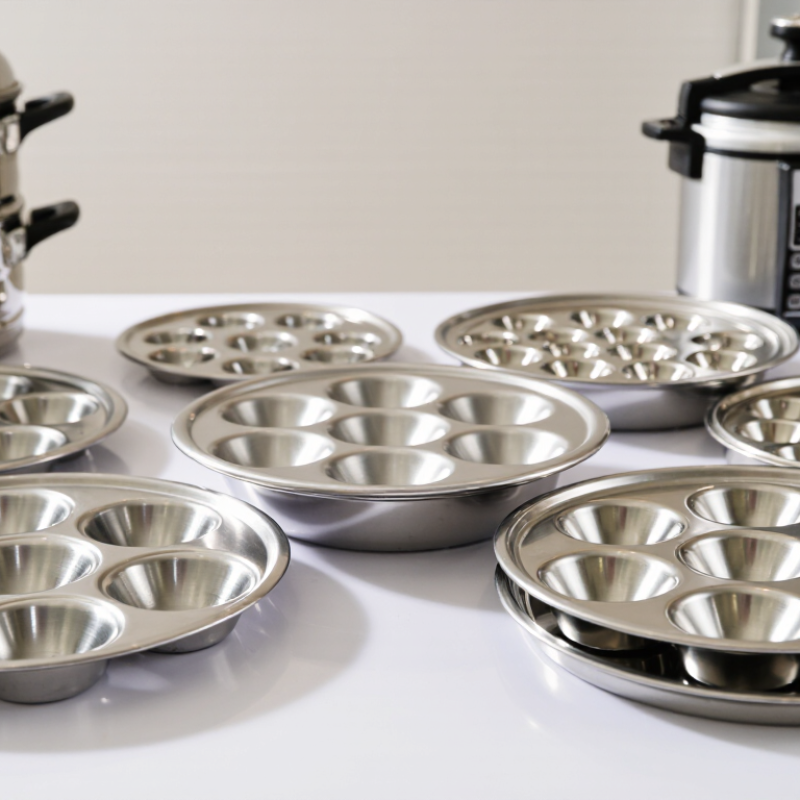
Choosing among the 7 best stainless steel idli steamer plates starts with the metal, not the shine. Food-grade steel commonly refers to 304 stainless steel, also called 18-8. It contains roughly 18% chromium and 8% nickel, although exact percentages vary within approved ranges. Chromium helps form a protective surface layer. Nickel improves corrosion resistance and supports durability during repeated steaming.
ASTM A240 is an important material specification for stainless steel plate, sheet, and strip. A supplier should provide a material test report showing the steel grade and chemical composition. However, ASTM A240 compliance alone does not prove that a finished idli plate is safe for every food-contact market. Weld quality, surface finishing, cleaning, and manufacturing controls also matter. A bright surface can still hide rough seams. That detail is easy to miss.
Tips: Look for clear grade information, smooth cup edges, secure stacking rings, and drainage-friendly design. Avoid plates with deep scratches, flaking finishes, or strong metallic odors. Ask whether the product uses 304 steel throughout, rather than only on the visible surface. In practical use, a plate that washes easily is often more reliable than one with a perfect mirror finish. I would also recheck the supplier’s certificate, because labels can be incomplete or loosely interpreted.
Four cavities suit a small breakfast. Five or six can work for two or three people. Larger households may prefer ten or twelve, but those plates need more batter and a wider pot.
No. Crowded plates can restrict steam circulation. Seven or eight cavities may offer a practical middle ground.
Measure the pot’s usable interior, not its outer rim. Check the plate diameter, central post opening, and available height. A small mismatch can be annoying.
Thin steel may flex or heat unevenly. Heavier steel can feel sturdier, but it may take longer to warm. Check that the base is flat and the metal looks consistent around the cups.
Test with filled moulds. Batter expands during steaming, and a low lid may flatten the tops. Leave space above the batter.
Condensation can drip from the lid. A domed lid or cloth barrier may help, though results vary by pot. It is worth checking during several steaming rounds.
Look at the steel grade, welds, holes, handles, and rim. Ask for a food-contact declaration. Appearance alone cannot confirm material suitability.
Not necessarily. Check the manual for temperature limits, detergent guidance, and drying instructions. Water trapped near welds may cause staining.
It should state the coverage period, proof required, exclusions, and replacement process. Keep the invoice and specification sheet; some warranties exclude warping or dishwasher damage.
Lift each tray and notice whether it scrapes your fingers. Photograph the plate’s markings before use. I once assumed a long warranty covered everything. That was a mistake.
Choosing the right Stainless Steel Idli & Steamer Plates starts with understanding the material. Food-grade 304 or 18-8 stainless steel is commonly valued for its corrosion resistance, while ASTM A240 can help identify relevant material specifications. When comparing seven plate options, consider capacity, diameter, and whether a 4-, 8-, or 12-cavity layout best suits your cooking needs.
Reliable steaming at about 100°C depends on more than plate size: thickness, a secure fit in the steamer, and enough lid clearance all affect performance. Check welds, gauge, corrosion resistance, and handle design for durability and easier handling. Before buying, confirm that the product is intended for food contact, review the maker’s care guidance for dishwasher use, and read the warranty terms. These checks help you select plates that are practical, safe to maintain, and suited to regular use.